

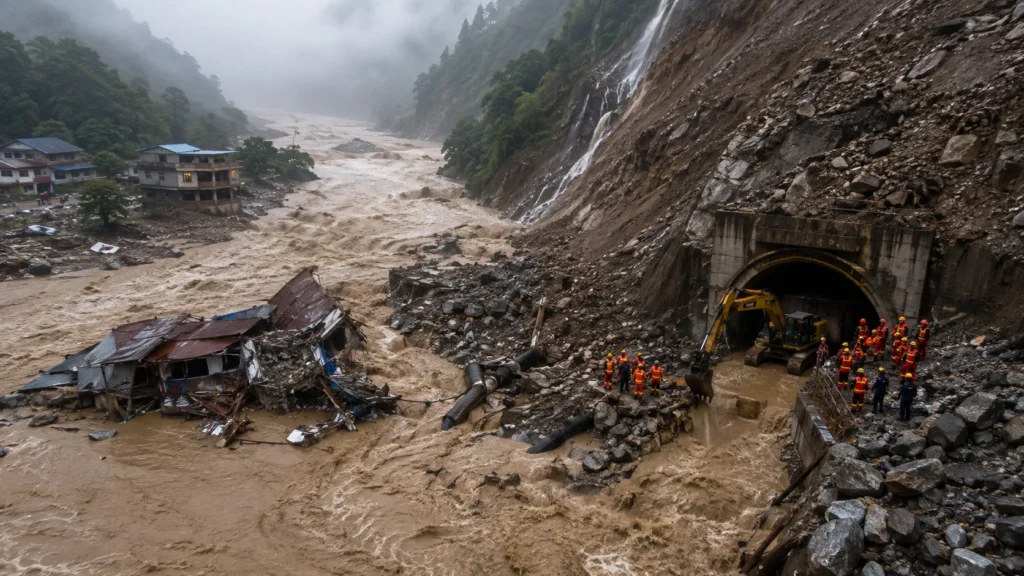

Nepal is facing a massive rescue and humanitarian challenge after devastating floods and landslides killed at least 903 people, with another 4,247 still reported missing. Rescue teams are now concentrating on one of the most difficult parts of the disaster: reaching hundreds of hydropower workers believed to be trapped inside tunnels filled with mud, water and debris.
The disaster has turned several remote hydropower sites in Nepal’s mountainous regions into major rescue zones. In Rasuwa and Nuwakot districts, emergency teams are working through damaged infrastructure in an effort to locate workers who disappeared after floodwaters swept through the area.
According to authorities, 933 hydropower workers are among those reported missing. The number has made the tunnel operations a priority because rescuers believe some workers could still be alive underground.
Nepal Flood: Rescue Efforts Move Underground
The biggest obstacle is the condition of the tunnels themselves. Floodwater carried enormous quantities of mud, stones and other debris into underground passages, blocking entrances and cutting off workers from the outside world.
Nepali security forces have been using excavation equipment, drilling methods and controlled blasts to clear routes into the affected tunnels. At some locations, rescue teams have also attempted to pump air into enclosed areas and use cameras to check whether survivors are present.
The operation has already produced some encouraging signs. Workers have been brought out from several affected hydropower facilities, while specialist teams continue searching areas where people remain unaccounted for.
India and China have also provided specialist assistance for the underground rescue effort. Their involvement is particularly important because tunnel operations in unstable mountainous terrain require specialised equipment and experience.
But rescuers face a difficult balance. Moving too quickly could destabilise already damaged tunnels, while delays could reduce the chances of finding survivors.
Nepal Flood: A Disaster Far Bigger Than the Tunnels
The missing hydropower workers are only one part of Nepal’s wider tragedy.
Thousands of people remain unaccounted for across the country. The floods swept away homes, vehicles, bridges and sections of roads, while powerful currents carried debris and victims far downstream.
The scale of the destruction has also created difficulties in identifying victims. Authorities are recovering bodies from different locations, while hospitals and morgues are under pressure to accommodate the growing number of casualties.
For families, the uncertainty has become another form of suffering. Many are still waiting for confirmation about relatives who disappeared during the floods.
The crisis has also affected foreign nationals. Hundreds of foreigners are among those reported missing, adding urgency to efforts to identify victims and locate survivors.
Roads Destroyed, Communities Cut Off
Nepal’s mountainous geography has made the emergency response particularly difficult. Several roads and bridges have been destroyed, cutting off communities that depend on them for access to hospitals, food and other essential supplies.
Nearly 40 kilometres of roads have reportedly been completely swept away. Helicopters have therefore become an important part of the response, particularly for areas that cannot be reached by road.
Nearly 21,000 security personnel, along with civilian workers and volunteers, have been involved in rescue and relief operations.
Despite improvements on some major routes, authorities continue to face difficult conditions in remote areas where landslides and unstable slopes can create new dangers for rescue crews.
The Himalayan Disaster Crosses Borders
The catastrophe has also affected neighbouring China, particularly Tibet, where floods and landslides caused additional deaths and disappearances.
China has deployed more than 2,100 rescuers and heavy equipment to affected areas. The disaster has damaged important infrastructure near the Nepal-China border, making movement and rescue operations harder.
The involvement of teams from Nepal, India and China reflects the scale of the emergency. What began as a disaster in a remote Himalayan region has quickly developed into a major cross-border humanitarian crisis.
Weather Remains a Major Threat
Even as rescue teams work around the clock, weather and geography continue to threaten their progress.
Rain can quickly raise river levels, while unstable slopes create the possibility of additional landslides. At some hydropower sites, rescue work has already been interrupted by rising water.
The suspected trigger was a major glacial collapse in the Himalayan region, which unleashed enormous volumes of water and debris into valleys below. The event demonstrates how vulnerable communities and infrastructure in the mountains can be when extreme natural events occur.
Nepal’s Rescue Mission Enters a Critical Phase
For Nepal, the coming hours and days will be crucial.
The immediate objective is clear: reach the people who may still be alive inside the blocked hydropower tunnels. Every section of mud removed could potentially open a route to survivors, but every unstable wall and rising river adds another danger for the people doing the rescuing.
Beyond the search operation, Nepal will face a much longer recovery. Thousands of families have lost homes or relatives, transport links have been destroyed and important hydropower infrastructure has suffered severe damage.
The official death toll of 903 already makes the disaster one of the country’s most devastating recent emergencies. With 4,247 people still missing, however, the final human cost remains unknown.
For rescuers underground and families waiting above ground, the mission has become a race against time. The hope is that behind the tonnes of mud and debris, some of the missing workers are still waiting to be brought home.
See more: Delhi-Mumbai Expressway
Follow us: bh24newsweb