

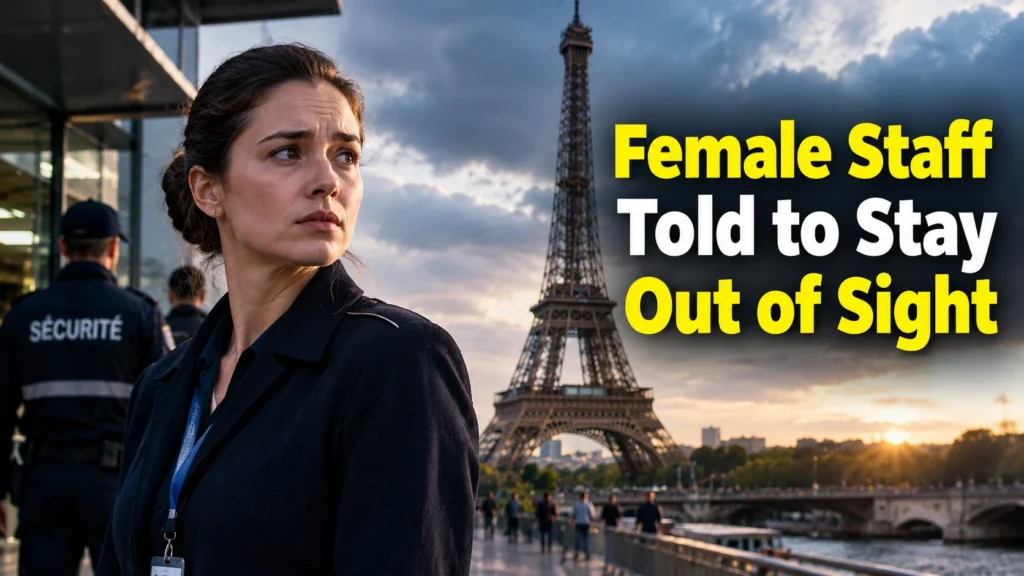

A visit by a large Hindu religious group to the Eiffel Tower has sparked a controversy in France after female employees were reportedly asked to move away from their usual positions while the delegation was at the landmark.
What began as a private visit has now turned into a debate over workplace equality, religious accommodation and the responsibility of management at one of France’s most famous public attractions.
The incident reportedly took place during a visit by around 100 members of the Bochasanwasi Akshar Purushottam Swaminarayan Sanstha, widely known as BAPS. The group was in France in connection with events surrounding a Hindu temple in the Paris region.
According to union representatives, some women working at the Eiffel Tower were told to step aside while the visiting group passed through certain areas. Male employees were reportedly positioned in their place.
For the affected workers, the issue was not simply about where employees were standing. They argued that moving staff based on gender crossed a line and created an unacceptable situation in the workplace.
The incident quickly caused anger among employees. Workers reportedly held discussions with management and raised concerns about whether such an arrangement could be allowed at a major public institution.
The dispute eventually had an impact on visitors. On Monday, the Eiffel Tower was temporarily closed as employees protested and met with management. The disruption meant tourists faced delays at one of Paris’s busiest attractions.
Management faces questions
The Eiffel Tower is operated by Société d’Exploitation de la Tour Eiffel, or SETE. The company has come under pressure to explain why female employees were reportedly asked to move.
The controversy has also raised questions about who approved the arrangement and whether management fully considered its implications before the visit.
For employees, the central concern is straightforward: workplace responsibilities should not be determined by whether a worker is male or female.
Management subsequently apologised to staff, according to union representatives, while authorities moved to examine the circumstances surrounding the incident.
The issue has attracted political attention in Paris as well. Officials have called for the matter to be investigated, particularly because the reported decision touches on the broader French principle of equality between men and women.
Religious sensitivity at the centre of debate
The presence of a Hindu religious delegation has added another layer to the controversy.
BAPS has said it did not ask for anyone to be denied entry or removed from the Eiffel Tower. The organisation said the group’s visit had been planned around the opening of the monument because of its size and to minimise disruption to other visitors.
BAPS also expressed regret over the controversy and apologised for any distress or inconvenience caused.
The organisation’s position has therefore been that the incident should not be interpreted as an attempt to exclude women from the landmark.
However, the controversy has shifted attention towards the actions of the Eiffel Tower’s management. Even if a visiting group has particular cultural or religious preferences, critics argue that a public workplace should not accommodate those preferences by treating employees differently because of their gender.
Why the incident has become significant
The Eiffel Tower is more than a tourist attraction. It is one of the strongest symbols of France and welcomes visitors from across the world.
That is why the reported incident has generated such a strong reaction.
France places considerable importance on equality in public life. The country’s approach to religion and public institutions is also shaped by laïcité, its distinctive model of secularism.
The debate therefore extends beyond one group and one visit. It raises a broader question: How far can a public institution go to respect the religious or cultural expectations of visitors without compromising the rights of its own employees?
Supporters of religious accommodation may argue that cultural sensitivities should be respected where possible. Critics, meanwhile, say accommodation should never result in women being sidelined at work.
Investigation expected to clarify events
Authorities are now expected to establish exactly what instructions were given to the female employees, who issued them and why.
Those details could be important in determining whether the incident resulted from a misunderstanding, a management decision or an attempt to meet specific expectations from the visiting delegation.
The employees’ protest has already forced the issue into the public spotlight.
The episode also serves as a reminder of the difficult balance international venues face when hosting large religious and cultural groups. Respecting different traditions can be important, but so is ensuring that workers are treated equally.
As the investigation continues, the Eiffel Tower controversy is likely to remain a talking point in France—not because of the landmark itself, but because of the much larger questions it has raised about gender equality, religious accommodation and the rights of workers in public spaces.