
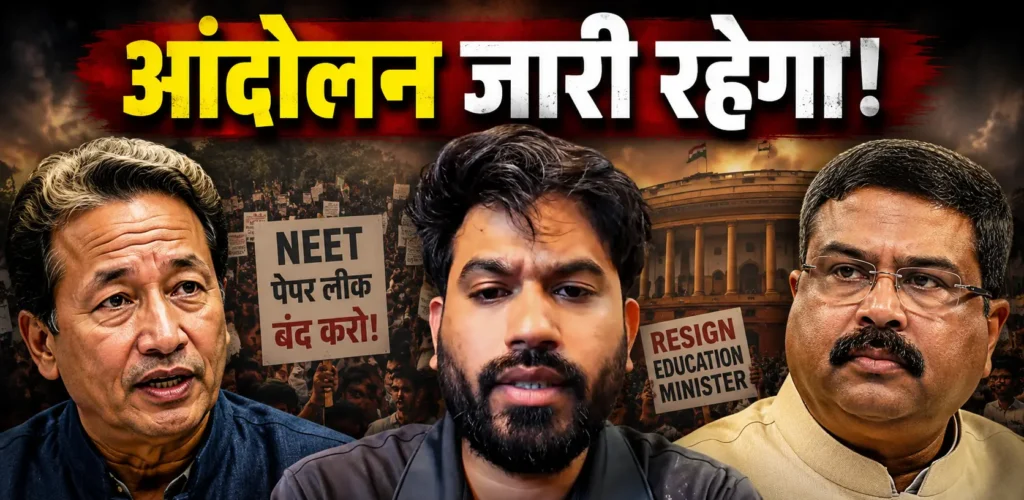

Social activist Sonam Wangchuk has ended his 26-day hunger strike, bringing one phase of India’s student-led protest movement to a close.
However, the larger agitation over the alleged NEET paper leak is far from over. Protesters are still demanding the resignation of Union Education Minister Dharmendra Pradhan.
Meanwhile, the youth-led Cockroach Janta Party (CJP) has announced peaceful demonstrations across the country. The organisation says the movement will continue until its main demand is fulfilled.
Why Did Sonam Wangchuk End His Fast?
Wangchuk began his indefinite hunger strike on June 28 in support of students protesting alleged irregularities in entrance examinations.
After nearly four weeks, he decided to end his fast following discussions with the Central Government.
According to Wangchuk, the decision came after receiving assurances that peaceful protesters would not face action. He also said he wanted to avoid any possibility of further violence during the ongoing agitation.
Before ending his fast, Wangchuk met Union ministers who discussed the concerns raised by the protesters.
CJP Makes Its Stand Clear
Although Wangchuk has ended his fast, CJP founder Abhijeet Dipke said the movement is not over.
Instead, he described it as the beginning of a new phase.
Dipke welcomed Wangchuk’s decision but repeated that the organisation would continue peaceful protests until Education Minister Dharmendra Pradhan resigns.
The campaign has grown into one of India’s largest youth-led movements in recent years. It has attracted support from students, professionals and several opposition leaders.
Government and CJP to Continue Dialogue
The Centre has already held discussions with representatives of the movement.
Another round of talks is expected as both sides try to find a solution.
The government has indicated that examination reforms and concerns over the alleged paper leak will remain on the agenda. It has also assured protesters that peaceful demonstrations will not face retaliatory action.
Political Pressure Continues to Build
The protest has increased political pressure on the government.
Several opposition parties have openly backed the students’ demands. They continue to seek accountability over the alleged examination irregularities.
At the same time, Prime Minister Narendra Modi has announced measures aimed at preventing future exam paper leaks. These include stricter laws and fast-track courts.
However, protest leaders argue that broader reforms and ministerial accountability remain necessary.
What Happens Next?
With Sonam Wangchuk ending his hunger strike, attention has now shifted to the next round of talks between the government and CJP.
The outcome of these discussions could shape the future of the movement.
If negotiations fail to produce a breakthrough, nationwide demonstrations are expected to continue.
For now, the protest remains one of the country’s most significant youth-led campaigns, with students waiting to see whether dialogue leads to meaningful action.
Read Also:
PM Modi Promises Tough Action Against Paper Leaks
Follow Us On Instagram: bh24newsweb