
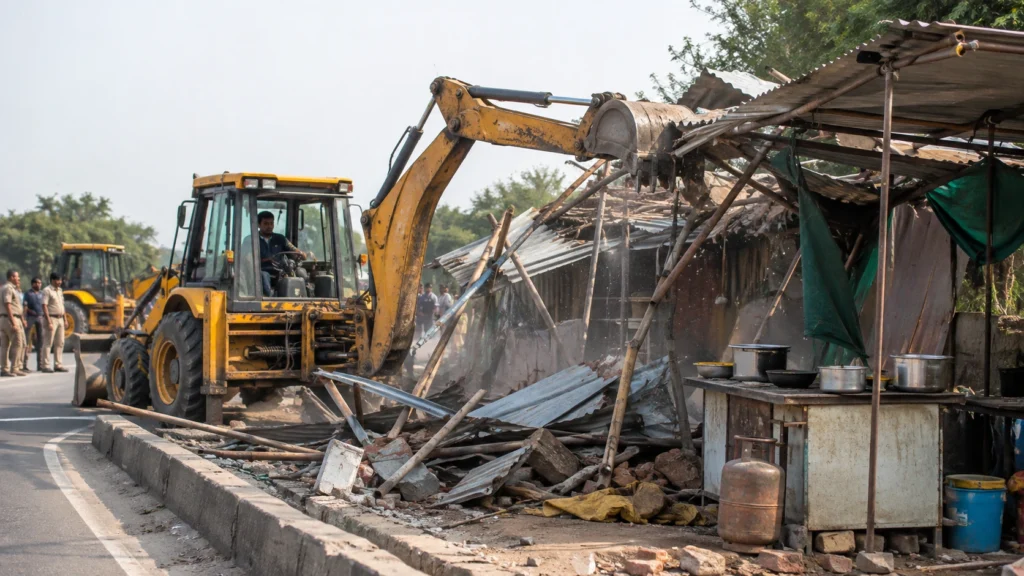

A major road-safety drive is underway in Maharashtra after the state government ordered local authorities to remove unauthorised dhabas, eateries, hotels and other commercial structures occupying the Right of Way (ROW) along National Highways.
The action follows a wider road-safety intervention by the Supreme Court after reports of fatal highway crashes in Rajasthan and Telangana claimed 34 lives in successive accidents. The court has since pushed states and highway authorities to address encroachments, unsafe parking and infrastructure gaps instead of treating serious crashes as isolated incidents.
Why Maharashtra Is Targeting Highway Dhabas
Roadside eateries are a familiar part of long-distance travel. However, the Supreme Court’s concern is not about food businesses in general. The focus is on establishments operating illegally or occupying land reserved for the highway.
The Maharashtra government has now given urban local bodies 60 days to identify and remove new and existing unauthorised structures located within the ROW of National Highways. New dhabas, eateries and commercial establishments are also barred from coming up in this reserved area.
The ROW is essentially the government-reserved corridor required for the highway and related infrastructure. Encroachments inside this space can interfere with traffic movement, road expansion, visibility and safety arrangements.
The state move is therefore part of a larger attempt to keep highway corridors free from activities that could create additional danger for motorists.
The 34 Deaths That Triggered Judicial Action
The Supreme Court took suo motu cognisance after reports highlighted two separate sets of fatal accidents in Rajasthan and Telangana. Together, the incidents resulted in 34 deaths.
The cases prompted the court to examine whether some highway deaths were being made more likely by preventable administrative and infrastructure failures.
The court noted that National Highways account for only about 2% of India’s total road length but nearly 30% of road fatalities. It consequently warned authorities against allowing highways to become what it described as “corridors of peril” because of administrative gaps.
That observation has shifted the conversation from simply blaming drivers after crashes to examining the conditions surrounding them.
Illegal Parking Is Another Major Concern
The Supreme Court’s directions go beyond roadside construction.
Heavy and commercial vehicles have been barred from stopping on National Highway carriageways and paved shoulders except at designated parking locations. This is significant because a stationary truck or commercial vehicle on a high-speed road can leave approaching drivers with very little time to react.
To enforce the rule, the court has called for greater use of technology. Cameras, speed detectors, variable-message boards, emergency call boxes, GPS-based photographic evidence and e-Challans are among the measures included in the road-safety framework.
Licences and Permissions Will Also Face Scrutiny
The crackdown could affect establishments that may have operated for years with local permissions.
Under the directions, authorities cannot simply grant or renew licences, No Objection Certificates or trade permissions for establishments located in highway safety zones without the necessary clearance from the NHAI or the Public Works Department.
Existing licences are also required to be reviewed within 30 days.
This makes the Maharashtra action more than a demolition exercise. It also puts the spotlight on how roadside businesses received permission to operate in sensitive highway areas in the first place.
NHAI Asked to Monitor Encroachments
The Supreme Court has also placed emphasis on continuous monitoring rather than occasional demolition drives.
Highway authorities have been directed to report inspections, encroachments and demolitions. The National Highways Authority of India has been asked to strengthen systems for receiving complaints from citizens about encroachments.
Drone surveys are also part of the monitoring plan, with surveys directed to be conducted twice a year.
The objective is to detect illegal construction before it becomes deeply established and harder to remove.
Road Safety Measures Go Beyond Demolitions
The court’s framework includes several other measures designed to reduce the impact of accidents.
District-level highway safety task forces are to be formed. Highways are also expected to have round-the-clock patrolling, with patrol vehicles equipped with tracking systems.
Emergency response has received particular attention. The directions call for Basic Life Support ambulances and recovery cranes at intervals of about 75 km on highway stretches.
Authorities have additionally been asked to identify and publicise accident blackspots and critical locations. High-intensity lighting, speed cameras, reflective warning signs and transverse road markings are among the recommended safety measures.
States Face Pressure to Show Compliance
The Supreme Court is also monitoring whether states are actually implementing its directions.
During a July 13 hearing, the court was informed that only Bihar, Karnataka and Puducherry had filed compliance affidavits. The bench warned that Chief Secretaries and Directors General of Police of states failing to comply could be summoned.
The matter is scheduled to come up again on August 17.
What Happens Next in Maharashtra?
The coming 60 days will test how seriously the new rules are enforced.
The challenge will not simply be identifying illegal structures. Authorities will also have to prevent fresh encroachments, coordinate between civic bodies, police, highway agencies and district administrations, and ensure that legitimate travellers still have access to safe and properly planned facilities.
For highway users, the intended result is straightforward: fewer roadside obstacles, safer stopping arrangements and faster emergency assistance.
For authorities, however, the Supreme Court’s message is broader. Road safety cannot begin only after a crash occurs. Highway design, enforcement, licensing, encroachment control and emergency response all form part of the responsibility to protect people using India’s busiest roads.
Maharashtra’s 60-day crackdown is therefore not just about removing dhabas. It is an attempt to reclaim highway space that was meant for safe movement and make authorities more accountable for what happens along it.
See more: Massachusetts Family Tragedy