
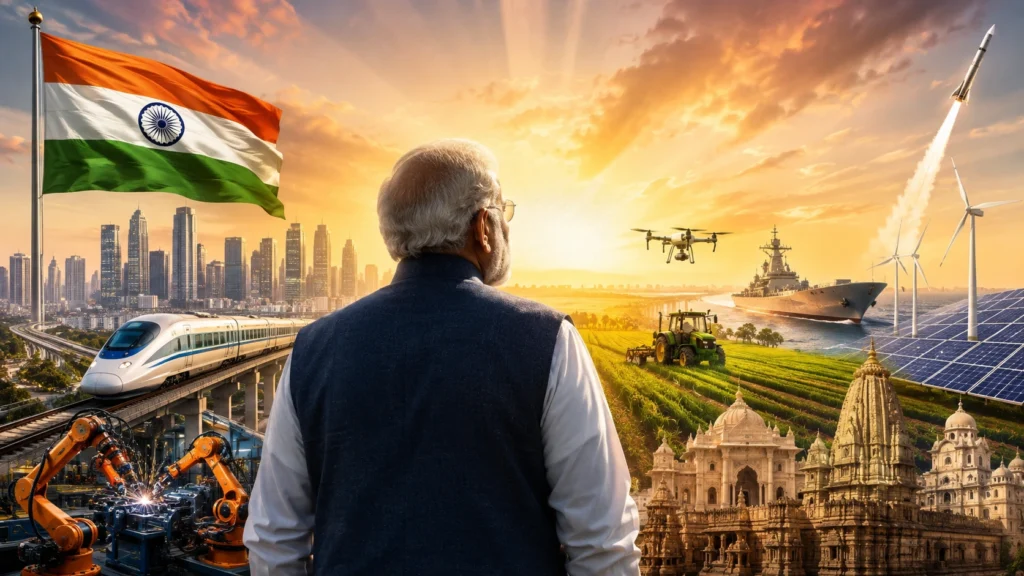

Prime Minister Narendra Modi has placed a fresh seven-point development framework at the centre of his vision for a Viksit Bharat by 2047. Called ‘Sapta Dhara’, the framework brings together seven areas that the government considers critical for India’s next phase of growth — from manufacturing and agriculture to technology, infrastructure, defence, sustainability and soft power.
The announcement came during the Prime Minister’s Independence Day address from the Red Fort. Rather than presenting development as the responsibility of a single sector, the Sapta Dhara approach links different parts of the economy and national life into one larger strategy.
Seven streams, one larger ambition
The first focus area is manufacturing. India wants to expand its role in global production and build stronger domestic industrial capabilities. The objective is not simply to manufacture more goods but to create an ecosystem that can attract investment, generate employment and make Indian products competitive internationally.
The second stream is agriculture and food processing. Agriculture remains a major source of livelihoods, and the government’s approach increasingly looks beyond farm production towards processing, storage and value addition. A stronger food-processing network can help reduce wastage while allowing agricultural products to reach larger markets.
The third pillar is technology and innovation. India’s future economic strength will increasingly depend on its ability to develop, rather than merely consume, advanced technology. Artificial intelligence, semiconductors, research and emerging technologies are therefore being positioned as important components of the development strategy.
Technology is also closely connected with the country’s youth. Modi has announced a target of training one crore young Indians in artificial intelligence, underlining the government’s attempt to prepare the workforce for an economy being reshaped by digital technologies.
Infrastructure as the backbone of growth
The fourth stream is Gati Shakti, which represents the infrastructure and connectivity push. Roads, railways, ports, logistics networks and other forms of connectivity are crucial to making economic activity faster and more efficient.
For manufacturers and exporters, better logistics can mean lower transportation costs and shorter delivery times. For ordinary citizens, improved infrastructure can mean easier movement, better access to markets and greater economic opportunities.
The idea is therefore to treat infrastructure not simply as construction but as an enabler for the rest of the economy.
Defence and strategic self-reliance
The fifth pillar focuses on defence power. India has been increasingly stressing domestic defence production and technological capability as part of its broader self-reliance agenda.
Building defence equipment within the country can serve two objectives at once: strengthening national security and creating a high-technology industrial base. Greater participation by domestic companies, startups and research institutions could also help develop capabilities in areas with both civilian and strategic applications.
This makes defence an economic issue as well as a security priority.
Green and blue opportunities
The sixth stream combines the green and blue economies. The green economy covers cleaner and more sustainable forms of growth, while the blue economy relates to economic opportunities connected with oceans and marine resources.
For India, energy security is closely tied to this transition. Expanding renewable energy and developing new technologies can reduce vulnerability to external energy shocks while opening new industries.
The blue economy, meanwhile, provides opportunities linked to India’s long coastline, maritime trade and ocean resources. Together, the two areas reflect an attempt to make future growth more sustainable without slowing economic expansion.
Soft power as a national asset
The seventh pillar is India’s soft power. Economic and military strength are only part of a country’s influence. Culture, traditions, knowledge, diplomacy and international partnerships can also shape how a nation is viewed around the world.
India’s growing global presence gives it an opportunity to use these strengths more strategically. Tourism, cultural exchanges, Indian knowledge traditions and international cooperation can all contribute to this wider influence.
Youth at the centre of the 2047 vision
An important thread running through the Sapta Dhara framework is the role of India’s young population. The government sees youth not only as beneficiaries of development but also as the people who will drive the country’s transformation over the next two decades.
This focus fits into the larger Viksit Bharat 2047 vision, which seeks to make India a developed nation by the centenary of Independence. The government has previously described youth participation and citizen involvement as essential to achieving this goal.
The emphasis on skills is particularly significant as technology changes the nature of employment. Preparing young people for artificial intelligence and other emerging sectors could determine how effectively India converts its demographic advantage into economic growth.
From framework to results
The real test of Sapta Dhara will not be the framework itself but its implementation. Each pillar involves complicated challenges — creating globally competitive companies, improving farm incomes, strengthening research, completing infrastructure projects, expanding defence manufacturing and balancing growth with environmental concerns.
The seven streams are also interconnected. Manufacturing needs reliable infrastructure. Agriculture benefits from technology and food processing. Defence requires advanced research. The green economy depends on innovation and investment. Soft power grows alongside economic and technological influence.
That interconnectedness is perhaps the central idea behind Sapta Dhara. India’s ambition to become a developed country cannot depend on one breakthrough or one sector. It requires progress across several fronts at the same time.
With the framework, the Modi government has presented a broad roadmap for the years ahead. The ultimate measure of success, however, will be whether these seven streams translate into more productive industries, better opportunities for young people, stronger national capabilities and improved living standards.
As India moves towards 2047, Sapta Dhara is being positioned as a framework through which economic strength, technological capability, national security, sustainability and global influence can move together towards the larger goal of a Viksit Bharat.
See more: Priyanka Chopra remembers Sridevi