

Kathmandu: In a disaster where roads have disappeared, tunnel entrances lie buried and familiar landmarks have vanished, rescuers in Nepal have found an unusual source of guidance — a WhatsApp group.
What began as a professional network of engineers has become an informal technical command centre following the devastating August 26 disaster in the Trishuli Valley. More than 500 engineers and specialists are exchanging drawings, tunnel information and practical advice to help rescue teams search for workers who may still be alive beneath hydropower project wreckage. The disaster sent an enormous wall of ice, rock, mud and water through the valley after a glacier collapse. The destruction hit hydropower installations particularly hard, with hundreds of workers in the area. Authorities believe roughly 900 people connected to six hydropower projects may be missing. Some may have taken shelter inside tunnels as the flood swept through the region. For rescuers, however, simply reaching those tunnels has become a major challenge.
Nepal flood: When the Maps No Longer Match the Ground
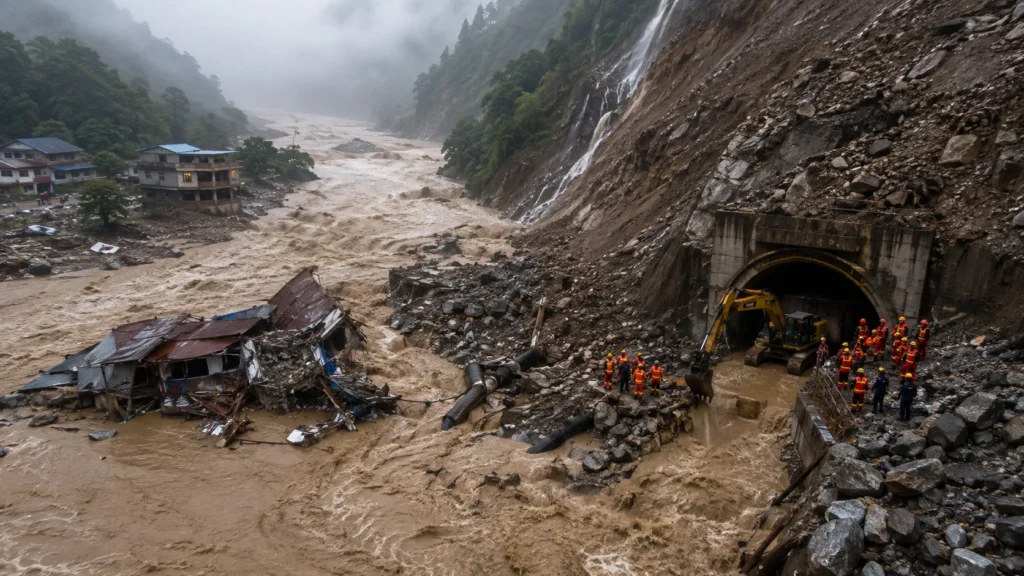
The flood did not merely block roads and entrances. It dramatically changed the landscape around the underground facilities. Mud and rocks now fill sections of tunnels, while debris completely covers some entrances. In places, the debris reaches the tunnel ceilings, making conventional access almost impossible. That is where engineers familiar with the projects have become critical. Rescue teams can send questions to the WhatsApp group and receive information from people who understand the facilities’ designs. Technical drawings can show where tunnels connect, where chambers sit and which routes may offer another way inside. Former hydropower plant workers have also shared their knowledge, giving rescuers insights that damaged or inaccessible sites cannot provide. The result combines modern communication with traditional rescue work: specialists far from the disaster zone can help guide excavators, soldiers and rescue personnel working among the debris.
Nepal flood: Two Men Give Nepal a Reason to Keep Searching
The biggest breakthrough came on September 4, when rescuers pulled two workers alive from a tunnel connected to the Upper Trishuli 3A hydropower project. They had survived underground for nine days. The rescue meant more than an isolated success. It changed the atmosphere of the wider search because it showed that people could survive inside the damaged tunnel network long after the initial disaster. Mechanical foreman Sanjay Sah later described how he stayed behind during the emergency after trying to help colleagues escape. Rescue teams eventually brought him and mechanical supervisor Kabir Maharjan out of the tunnel and took them to Kathmandu for medical treatment. Their survival has strengthened hopes for other missing workers.
Rescue Teams Are Still Fighting the Clock
At the Rasuwagadhi hydropower plant, rescuers advanced roughly 250 metres into a tunnel before they encountered a blockage. Officials believe dozens of people could remain trapped in a chamber there, potentially with access to food and water. Meanwhile, teams at Upper Trishuli 3A needed several days just to reach the buried tunnel entrance. Rescuers are using heavy machinery and other equipment to remove material blocking the passages. They have also supplied oxygen through pipes toward possible cavities in the hope that trapped workers can continue breathing. But every move carries a risk. The flood destabilised the terrain, while mud and rocks altered the tunnels’ original structure. Authorities have warned that rescuers face more than a routine blockage. Another collapse could endanger both trapped workers and rescue teams.
A Disaster That Hit Nepal’s Power Network
The human toll represents only one part of the crisis. Nepal’s growing hydropower sector also suffered severe damage. The disaster affected several projects and wiped out an estimated 10% of the country’s electricity-generation capacity. These facilities matter because hydropower supplies much of Nepal’s electricity and supports its plans to sell surplus power to neighbouring countries. Yet rebuilding the energy network will have to wait. For families whose relatives remain missing, the priority remains finding people underground.
Hope Inside the Tunnels
The engineers’ WhatsApp group shows how ordinary technology can acquire extraordinary importance during a disaster. No single piece of technology is carrying out the rescue. Instead, teams are combining maps, engineering experience, mobile communication, heavy machinery, oxygen equipment and former workers’ knowledge in real time. Every drawing shared in the group could help rescuers identify a passage. A message from a former worker might prevent teams from wasting precious hours. Each metre of debris they remove could bring them closer to someone waiting underground.
The rescue of two workers after nine days has given those efforts new urgency. Nepal is still searching for many others. Across the damaged Trishuli Valley, rescue teams continue digging through tunnels that once formed part of the country’s expanding hydropower network. Above ground, families wait for news. Underground, rescuers continue looking for signs of life. In the background, hundreds of engineers remain connected through a WhatsApp group — turning their technical knowledge into a lifeline for a rescue operation where every minute matters.
see more: Mirzapur