

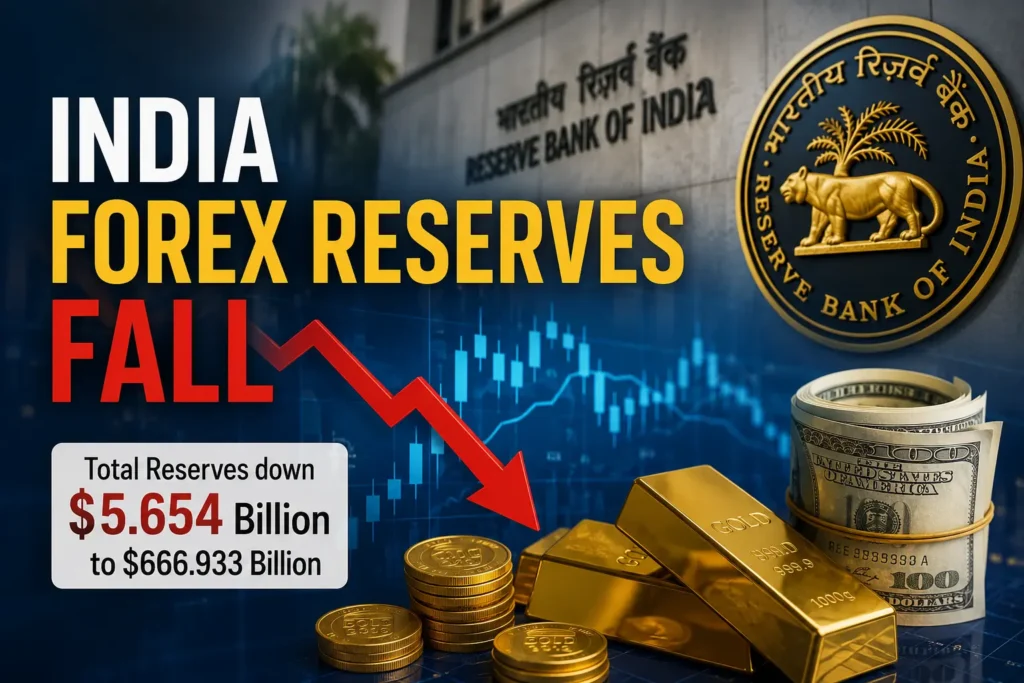

India Forex Reserves witnessed a significant decline during the week ended June 26, 2026, with the Reserve Bank of India (RBI) reporting a fall of USD 5.654 billion, bringing the country’s total foreign exchange reserves down to USD 666.933 billion. The decline was primarily driven by a steep drop in the value of gold reserves, while other components of the reserve basket also registered marginal decreases.
Gold Reserves Lead the Decline
According to the latest RBI data, India’s gold reserves recorded the biggest weekly fall, declining by USD 5.394 billion to USD 102.536 billion. Gold is an important component of the country’s reserve portfolio, and fluctuations in its market value can have a noticeable impact on overall forex reserves.
Meanwhile, Foreign Currency Assets (FCA), which account for the largest share of India’s foreign exchange reserves, slipped by USD 150 million to USD 541.067 billion. The value of FCAs also reflects movements in currencies such as the euro, pound sterling and Japanese yen against the US dollar.
The value of India’s Special Drawing Rights (SDRs) declined by USD 89 million to USD 18.558 billion, while the country’s reserve position with the International Monetary Fund (IMF) eased by USD 21 million to USD 4.77 billion.
Why Are Forex Reserves Falling?
India’s forex reserves serve as a crucial financial buffer, helping the country manage external shocks, stabilize the rupee, finance imports and maintain investor confidence.
Although the RBI has not attributed the latest decline to a single factor, economists generally point to a combination of valuation changes in reserve assets and central bank interventions in the foreign exchange market. When the RBI sells dollars to curb excessive volatility in the rupee, the overall reserve stock can decline. Changes in global gold prices and currency movements also influence reserve valuations.
From Record High to Recent Decline
The latest figures come just months after India achieved a record forex reserve level of USD 728.494 billion in the week ending February 27, 2026. Since then, reserves have gradually moderated amid increased volatility in global financial markets and pressure on emerging market currencies.
Despite the recent decline, India continues to maintain one of the world’s largest foreign exchange reserve holdings, providing a substantial cushion against external economic risks and supporting overall macroeconomic stability.
What It Means for the Indian Economy
A fall in reserves does not necessarily indicate economic weakness. Weekly reserve data often fluctuate due to exchange-rate movements, changes in global asset prices and RBI operations. Analysts generally monitor longer-term trends rather than a single week’s movement.
However, sustained declines could reduce the central bank’s flexibility in defending the rupee during periods of heightened market volatility. Investors will continue to watch upcoming RBI data releases to assess whether the recent drop represents a temporary correction or the beginning of a broader trend.
For now, India’s reserve position remains robust by global standards, although recent figures highlight the challenges posed by volatile international financial markets and changing currency valuations.
Read Also: BAT-BMS App Removed
Follow Us on Instagram: bh24newsweb