
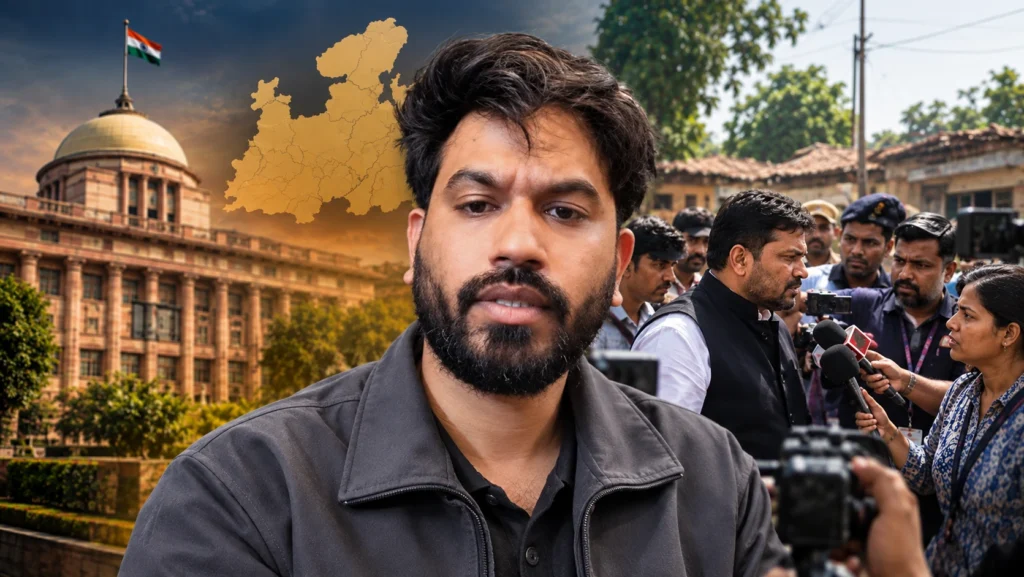

A political drama has unfolded in Madhya Pradesh after Cockroach Janta Party (CJP) founder Abhijeet Dipke used an unusual way to attack the state government. A day after his visit to Balaghat turned tense, Dipke posted a mock resignation letter in which he presented himself as the Chief Minister of Madhya Pradesh.
The post was not an actual resignation. Dipke is not the state’s Chief Minister. Instead, the letter was designed as political satire and was aimed at highlighting what he described as the government’s failures.
The move, however, created a fresh controversy. While some social media users supported his criticism of the BJP-led Madhya Pradesh government, others accused him of using an official-looking format and demanded legal action.
Why did Dipke post the ‘resignation’ letter?
The unusual post came soon after Dipke’s visit to tribal areas of Balaghat. He had travelled to villages including Adori, Korka and Bondari to meet families affected by the deaths of children following reported infections.
Dipke’s visit was linked to growing concerns over healthcare conditions in the region. More than 30 tribal children have reportedly died in the area in recent months, leading to questions over medical facilities, nutrition and other basic services.
Instead of simply issuing another political statement, Dipke chose satire to make his point.
In the letter, he wrote as though he were the Madhya Pradesh chief minister and accepted responsibility for the deaths and other issues facing the state. He also addressed the letter to the Governor and tagged Prime Minister Narendra Modi in his social media post.
The tone was deliberately sarcastic. Dipke suggested that the fictional chief minister had failed to fulfil his responsibilities and therefore had no moral right to continue in office.
Balaghat visit had already created a stir
The resignation post followed an incident during Dipke’s Balaghat visit that quickly attracted attention online.
A video circulating on social media showed a woman approaching Dipke with a microphone while he was leaving in a vehicle. She questioned his presence in the area and asked whether he had come to engage in politics over the deaths of the children.
Dipke appeared to apologise for arriving late. The exchange became increasingly heated. Members accompanying the CJP leader then moved him into another vehicle.
As he left, the woman was heard saying that he had “run away”.
The video soon became part of the wider political discussion surrounding his visit. Some local journalists reportedly questioned why a group of social media influencers from outside the area had arrived at the remote location. They also raised questions about whether the confrontation was deliberately organised. Those suggestions, however, have not been independently established.
Child deaths remain the bigger issue
Behind the political exchange is a much more serious concern.
The deaths of tribal children in Balaghat have triggered scrutiny of the healthcare system in the affected areas. The Madhya Pradesh High Court has sought responses from state authorities after a petition raised concerns about the situation.
The petition reportedly highlighted problems including overcrowded healthcare facilities, drinking water concerns and poor nutrition. It also raised questions about whether local medical infrastructure is sufficient to handle the number of patients in the region.
These are allegations and issues raised before the court, rather than findings that can automatically be treated as proven.
Dipke used these concerns to question the state government’s accountability. His satirical letter also referred to other controversies, including the Sagar illicit liquor tragedy.
Social media divided over the move
Dipke’s post quickly turned into a debate of its own.
One section of social media users backed his criticism. They argued that the satirical letter drew attention to issues that deserved answers from the government.
Another group focused on the appearance of the document. Critics alleged that Dipke had used official-looking letterhead and the State Emblem in a political communication.
Some users, including people identifying themselves as BJP supporters, called for an FIR and investigation. They questioned whether the document could amount to an unauthorised representation of a constitutional office.
At this stage, these are demands and allegations made on social media. They should not be treated as an established legal finding.
A political stunt or a serious message?
The controversy has therefore taken two different directions.
For Dipke and those supporting him, the mock resignation was a way to draw attention to the condition of tribal families and alleged shortcomings in governance. For his critics, the format of the letter crossed a line by appearing similar to an official government document.
The timing also made the post more politically charged. It came immediately after the confrontation in Balaghat, turning what might have remained a local dispute into a larger social media story.
The episode has once again highlighted how political communication is changing. Satire, viral videos and social media posts can now turn a local confrontation into a statewide controversy within hours.
For Balaghat’s affected families, however, the central issue remains far more important than the online political battle: why so many children died, whether healthcare facilities were adequate and what steps authorities are taking to prevent similar incidents.
As the controversy over Dipke’s satirical resignation continues, attention is likely to remain divided between the political allegations and the underlying concerns about public health and tribal welfare in Balaghat.
See more: Famous Ganesh Temples to Visit in September 2026
Follow us: bh24newsweb