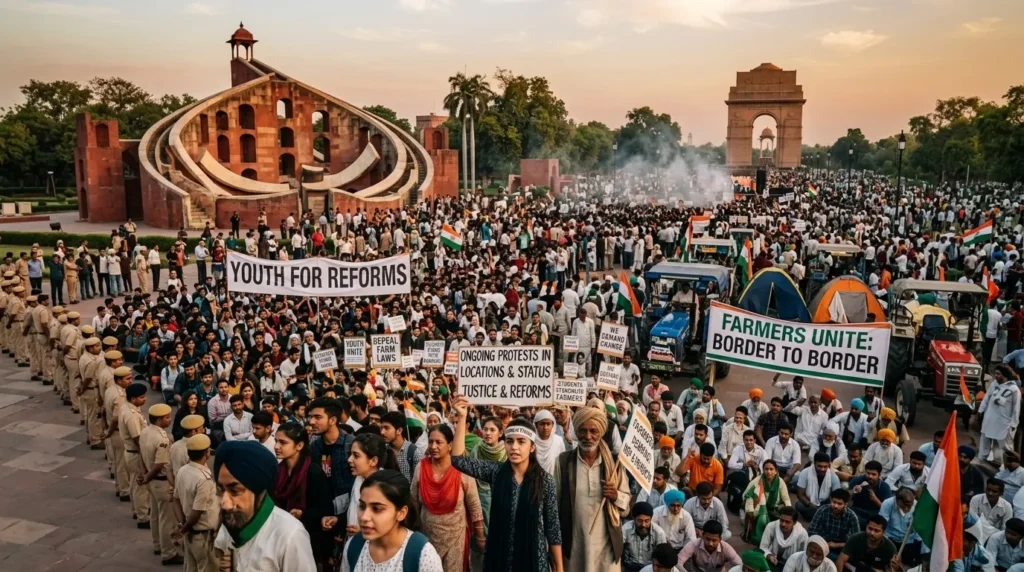
Massive ongoing protests in India showing a joint demonstration of Gen Z students from the Cockroach Movement and farmers with tractors near Jantar Mantar and India Gate in Delhi.

Ongoing Protests in India: Demands, Locations, and Current Status

8 0
India is currently facing a wave of massive civic unrest. From students demanding educational accountability to farmers guarding their livelihoods, public demonstrations are intensifying across the country. Understanding these movements is critical because they actively shape the socioeconomic fabric of the nation.
Consequently, this comprehensive analysis details the most important ongoing protests in India. We look at their core triggers, geographic epicenters, and real-time status.

1. The Gen Z ‘Cockroach Movement’ (Delhi)

The most prominent demonstration shaking the country’s capital is the youth-led “Cockroach Movement”. Organized under the banner of the Cockroach Janta Party (CJP), this group has triggered massive nationwide attention. What originally began as online political satire has rapidly evolved into one of the largest student rebellions in recent Indian history.
Primary Location - Jantar Mantar and Parliament Marg, New Delhi
Key Figures - Abhijeet Dipke (CJP Founder), Sonam Wangchuk
Core Grievance - NEET-UG paper leaks and systemic exam corruption

Why Are They Protesting?

The unrest exploded following systemic failures in national examinations. Most notably, a massive NEET-UG paper leak compromised the future of over two million medical aspirants.

As a result, the CJP and its young supporters are demanding the immediate resignation of Union Education Minister Dharmendra Pradhan. Furthermore, they are seeking strict legislative reforms against bureaucratic corruption. They also want a ₹1 crore compensation package for the families of students who tragically died by suicide due to examination stress.

Current Status

The situation escalated dramatically on July 20, 2026. Over 10,000 protesters broke through multiple police barricades during a march toward Parliament. Law enforcement responded heavily, deploying tear gas, baton charges (lathicharge), and internet shutdowns.
Meanwhile, authorities forcibly institutionalized veteran activist Sonam Wangchuk. He had been on a 21-day hunger strike in solidarity with the youth. Following clashes that left over 150 youth injured, CJP leadership announced a temporary halt to active marching. However, daily demonstrations at Jantar Mantar remain highly active under heavy paramilitary surveillance.

2. Renewed Farmers’ Protests and the ‘Desh Bachao Morcha’

Agrarian unrest has returned to India’s highways as major agricultural unions unite against international trade policies. This marks another critical phase of ongoing protests in India.

Why Are They Protesting?

Under the collective umbrella of the Desh Bachao Morcha (DBM), hundreds of farm unions are fiercely opposing a proposed India-US Free Trade Agreement (FTA).
Specifically, farmers fear the bilateral trade deal will slash tariffs. This policy could flood local markets with heavily subsidized American agricultural goods like soybean oil and dairy. Smallholders argue they cannot compete with large-scale US corporate farming. Therefore, alongside abandoning the trade pact, farmers are reviving their core demand for a statutory, legally guaranteed Minimum Support Price (MSP).

Current Status

On July 21, 2026, police forces stopped thousands of farmers heading toward a planned “Kisan Mahapanchayat” rally in New Delhi. Authorities have completely sealed the Shambhu-Ambala and Khanauri-Jind borders connecting Punjab and Haryana with concrete blocks.
Additionally, law enforcement detained prominent farm leaders, including BKU’s Gurnam Singh Charuni. While police halted vehicular convoys at the state boundaries, many farmers abandoned their vehicles. They are now proceeding toward Delhi on foot. Leaders state that the movement will intensify if the government pushes forward with the trade deal.

3. Environmental and Displacement Protests

Beyond Delhi and the northern borders, crucial environmental conflicts are driving localized but fierce resistance movements. These regional actions add to the complexity of ongoing protests in India.
    • Ken-Betwa River Link Project (Madhya Pradesh): In the Bundelkhand region, local indigenous tribal families and environmentalists are staging unique “chita” (funeral-pyre) protests. They are fighting against mass displacement, loss of ancestral forest lands, and severe threats to local wildlife.
    • Shivalik Tree Felling Resistance (Uttarakhand): Environmental coalitions recently marked a “Black Harela” day to protest the planned felling of over 4,000 trees. The tree removal accommodates a highway development project within the Shivalik Elephant Reserve. Citizens are now adopting classic tree-hugging tactics to stall the development.

Analytical Conclusion: A Changing Landscape of Dissent

A structural shift is visible in how ongoing protests in India operate. Dissent is no longer restricted to traditional political party alignments. For instance, the rising influence of Gen Z networks online has completely democratized mobilization. We see clear proof of this in the Cockroach Movement’s rapid physical expansion.

Concurrently, the trust deficit between rural communities and state policymakers keeps the agrarian borders volatile. While the government has made minor outreach attempts, the widespread deployment of security barricades indicates that a definitive resolution remains far off.

Read Also:

Ken-Betwa Project Protest: MP में ‘चिता’ और ‘फांसी’ सत्याग्रह क्यों कर रहे आदिवासी परिवार?
Follow Us on Instagram: bh24newsweb


Related Post

Leave a comment

Your email address will not be published. Required fields are marked *