
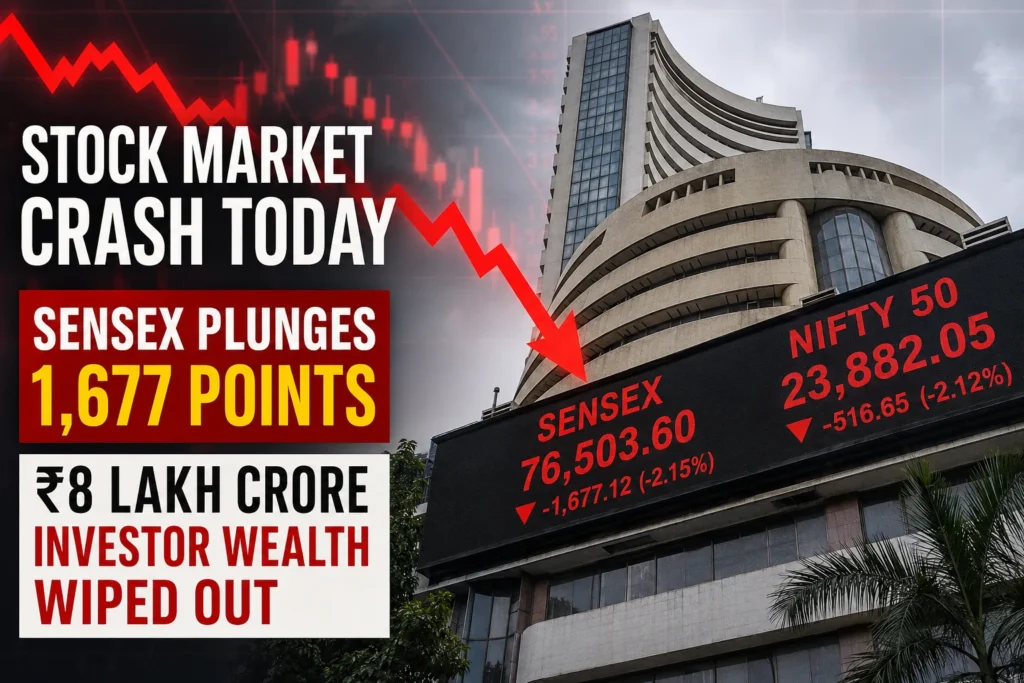

Mumbai: The Stock Market Crash shocked investors across India. The Sensex and Nifty recorded their biggest single-day fall in months. Nearly ₹8 lakh crore in investor wealth disappeared as heavy selling hit Dalal Street.
The sharp decline followed rising global tensions and a jump in crude oil prices. These developments weakened investor confidence and triggered panic selling across sectors.
Why Did the Stock Market Crash?
The Stock Market Crash was driven by several global and domestic factors. Fresh geopolitical tensions in the Middle East increased uncertainty in financial markets. As a result, crude oil prices climbed sharply.
Higher oil prices raised fears of inflation. Investors also worried about slower global economic growth. These concerns led many traders to sell their holdings.
Foreign Institutional Investors (FIIs) continued selling Indian equities. Profit booking after the recent market rally added more pressure on the indices.
Sensex and Nifty Record Sharp Losses
The BSE Sensex closed at 76,503.60, down 1,677.12 points, or 2.15%. The NSE Nifty 50 ended at 23,882.05, losing 516.65 points, or 2.12%.
Almost every major sector finished in the red. Banking, IT, auto, metal, and financial stocks recorded heavy losses. Mid-cap and small-cap stocks also declined as investors shifted towards safer assets.
What Investors Should Know After the Stock Market Crash
Market experts believe volatility may continue in the coming days. They expect investors to closely watch crude oil prices, global events, foreign investment flows, and upcoming corporate earnings.
Despite the sharp fall, experts have advised investors not to panic. They recommend focusing on long-term financial goals instead of reacting to short-term market movements. A diversified portfolio can help reduce risk during volatile periods.
What Happens Next?
The Stock Market Crash highlights how global events can quickly affect Indian markets. Analysts believe market sentiment will depend on international developments and economic data over the next few days.
If global tensions ease, investor confidence could improve. However, markets may remain volatile until there is greater clarity.
For now, experts advise investors to stay patient, avoid panic selling, and make investment decisions based on long-term fundamentals.
Visit: National Stock Exchange