
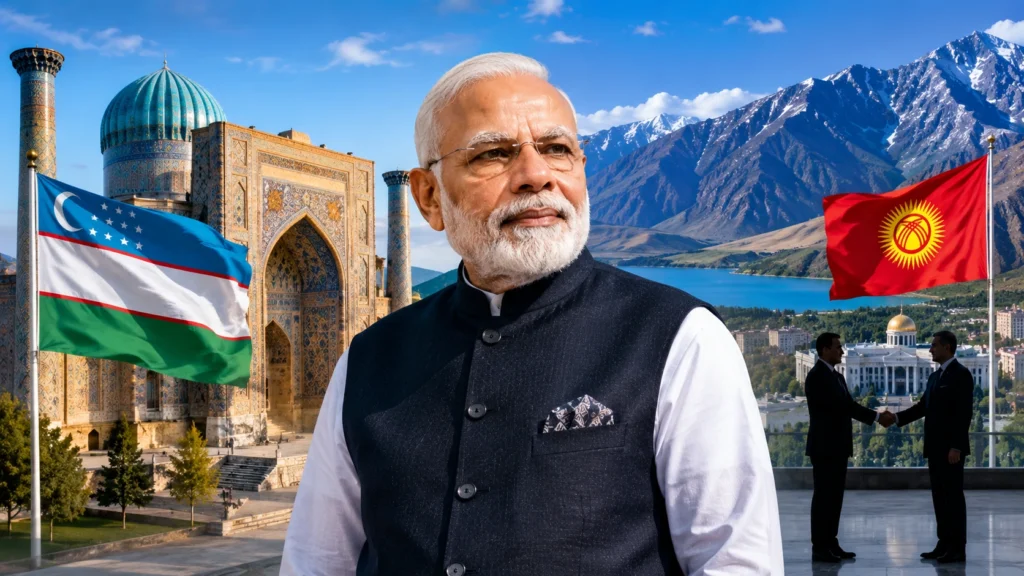

Prime Minister Narendra Modi’s four-day visit to Uzbekistan and the Kyrgyz Republic comes at a time when Central Asia is becoming increasingly important in India’s foreign-policy calculations. From energy and critical resources to connectivity, counter-terrorism and strategic competition, the region offers New Delhi both opportunities and challenges.
Modi will visit Uzbekistan on August 29 and 30 for a state visit before travelling to Bishkek in the Kyrgyz Republic for the 26th Shanghai Cooperation Organisation (SCO) Summit from August 31 to September 1. The visit will combine bilateral diplomacy with wider regional engagement.
Central Asia is no longer a distant region for India
Central Asia may appear geographically distant from India, but its location gives it considerable strategic value. Kazakhstan, Kyrgyzstan, Tajikistan, Turkmenistan and Uzbekistan sit at the crossroads of major Eurasian powers, with Russia, China, Afghanistan and Iran all connected to the region. For India, developments in Central Asia have implications for security, energy supplies, trade routes and the wider balance of power in Eurasia. New Delhi’s engagement with the five countries became more focused after the launch of the Connect Central Asia policy in 2012. Modi later travelled to all five republics during his 2015 visit, giving a major push to India’s regional outreach. The latest tour signals that the relationship is moving beyond occasional diplomatic contact towards a broader strategic partnership.
Uzbekistan at the centre of the visit
The first leg of Modi’s journey will take him to Tashkent, where he will meet Uzbek President Shavkat Mirziyoyev. India and Uzbekistan have gradually expanded cooperation in several sectors. This time, discussions are expected to cover trade and investment, defence, digital connectivity, energy, education and people-to-people relations. The two sides are also expected to discuss their respective development ambitions, including India’s Viksit Bharat 2047 and Uzbekistan’s development programme. The economic relationship could be particularly important. Uzbekistan is pursuing industrial and infrastructure development, while India has strengths in pharmaceuticals, healthcare, information technology, education and other services. There is also a strong historical connection. Centuries of movement across Central Asia created cultural links with the Indian subcontinent. Modi’s planned visits to the Lal Bahadur Shastri Memorial and the Mahatma Gandhi Centre in Tashkent underline this people-to-people dimension.
Energy and critical resources matter
One of India’s biggest interests in Central Asia is access to natural resources. The region possesses significant reserves of energy resources and minerals that could become increasingly valuable as countries compete for supplies needed by modern industries. For India, diversification of energy and mineral sources is important. As the country expands manufacturing, renewable energy, electric mobility and advanced technologies, secure access to strategic resources will become an increasingly important part of foreign policy. This makes stronger relationships with Central Asian governments economically useful as well as strategically valuable.
Connectivity remains the biggest hurdle
There is, however, a major problem: geography. India does not have a direct land corridor to Central Asia. Pakistan’s territory blocks a straightforward overland route, forcing India to explore alternative connectivity arrangements. This is why projects involving Iran and the broader International North-South Transport Corridor have strategic importance for New Delhi. Better transport links could make it easier for Indian businesses to reach Central Asian markets and could strengthen India’s economic presence in the region. Connectivity is therefore not simply about moving goods. For India, it is also about ensuring that Central Asia remains accessible despite difficult geography.
Security and Afghanistan
Security is another major reason India wants deeper engagement with the region.
Central Asian countries are close to Afghanistan, where instability, terrorism, extremism and narcotics trafficking remain concerns. Any deterioration in Afghanistan can have consequences for neighbouring states and the wider region. India therefore has an interest in maintaining regular security dialogue with Central Asian governments and working with them on counter-terrorism and regional stability. This is also expected to feature prominently at the SCO Summit, where Modi has said India will push for a region free from terrorism, separatism and extremism.
The SCO gives India a wider platform
The second part of Modi’s journey will take him to Bishkek for the SCO Summit. India has been a full member of the organisation since 2017. The grouping brings together major Eurasian powers and provides New Delhi with a platform to engage simultaneously with countries that have different strategic interests. The 2026 summit is particularly significant because it marks 25 years of the SCO. Modi is expected to highlight India’s priorities of Security, Connectivity and Opportunity while also holding bilateral meetings with other participating leaders. He will also attend the opening ceremony of the sixth World Nomad Games, adding a cultural dimension to the visit.
A long-term strategic calculation
Modi’s Central Asia tour is ultimately about building India’s presence in a region where strategic competition is intensifying. India cannot change its geography, but it can create stronger diplomatic, economic and security partnerships that overcome some of those limitations. The challenge will be turning political goodwill into actual trade, investment, connectivity and long-term projects.
For New Delhi, Central Asia offers an important combination of resources, markets, security cooperation and strategic access. The Uzbekistan and Kyrgyz Republic visit is therefore not merely a diplomatic engagement. It is part of India’s broader attempt to secure a meaningful role in the changing geopolitical landscape of Eurasia.
See more: Nepal floods