

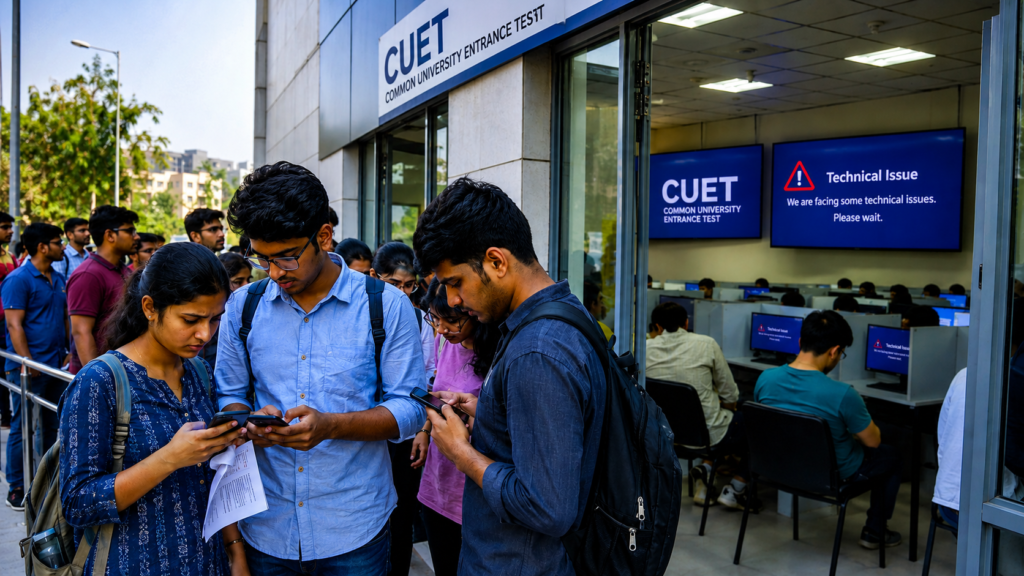

The recent CUET exam delay at multiple examination centers has once again brought India’s examination system under scrutiny. Although the National Testing Agency (NTA) clarified that the disruption resulted from a technical issue, the incident has sparked criticism from political leaders, students, and education experts.
The CUET exam delay comes at a time when the NTA and the Education Ministry are already facing scrutiny over issues related to major examinations, including the NEET-UG controversy and recent debates surrounding CBSE examination processes. As university admissions become increasingly competitive, students expect a smooth and transparent testing process. Any disruption, even a temporary one, can raise concerns about preparedness and accountability.
What Caused the CUET Exam Delay?
According to officials, the CUET exam delay occurred because of a technical glitch at selected examination centers. Candidates reportedly experienced waiting periods before the test could begin.
The National Testing Agency later issued a clarification, stating that the issue was operational rather than related to examination security. Authorities emphasized that the problem was resolved quickly and that candidates were able to complete their tests.
While the agency described the disruption as temporary, many students expressed concerns about the stress and uncertainty created by the delay.
Why the CUET Exam Delay Has Become a Major Talking Point
The CUET exam delay attracted significant attention because it followed a series of discussions surrounding the administration of major examinations in India.
Over the past few years, several competitive examinations have faced challenges ranging from technical disruptions to allegations of irregularities. As a result, every new incident tends to receive heightened public attention.
Education experts believe that the latest controversy reflects broader concerns regarding examination infrastructure and operational preparedness.
Furthermore, social media platforms amplified student reactions, making the issue a national discussion within hours.
NTA Clarification on the CUET Exam Delay
In response to growing criticism, the National Testing Agency released an official statement regarding the CUET exam delay.
According to the agency:
- The disruption was caused by a technical issue.
- Examination security remained intact.
- Candidates completed their tests after the problem was resolved.
- Necessary corrective measures were implemented immediately.
The NTA also emphasized that the integrity of the examination process was not compromised.
This clarification aimed to reassure students, parents, and universities that the entrance examination remained fair and credible.
Political Reactions Following the CUET Exam Delay
The CUET exam delay quickly became a political issue.
Opposition leaders questioned whether sufficient measures were in place to prevent recurring examination disruptions. Several critics argued that students should not face uncertainty during important academic assessments.
Government representatives, however, maintained that technical glitches can occur in large-scale examinations and highlighted the steps taken to resolve the issue promptly.
The debate has intensified discussions about how national examinations are managed and monitored across the country.
How the CUET Exam Delay Affected Students
For thousands of candidates, the CUET exam delay was more than just a scheduling inconvenience.
Increased Examination Stress
Students often spend months preparing for entrance examinations. Unexpected delays can increase anxiety and affect mental readiness.
Disrupted Focus and Concentration
Many candidates prepare mentally for a specific examination time. Any delay can make it difficult to maintain focus throughout the test.
Travel and Accommodation Concerns
Some students travel considerable distances to reach examination centers. Delays can create additional logistical challenges and expenses.
Concerns About Fairness
Although the NTA stated that examination security remained unaffected, some candidates raised questions about maintaining consistent testing conditions.
Why CUET Has Become One of India’s Most Important Entrance Exams
Understanding the significance of the CUET exam delay requires understanding the importance of the examination itself.
The Common University Entrance Test serves as a centralized admission process for many universities across India. Instead of relying solely on school board marks, institutions use CUET scores to evaluate applicants through a common framework.
As participation continues to grow, the examination has become one of the most influential gateways to higher education in the country.
Because of this importance, even minor disruptions attract widespread public and media attention.
What the CUET Exam Delay Reveals About Digital Examination Challenges
The CUET exam delay highlights several challenges associated with conducting large-scale computer-based examinations.
Technical Infrastructure Requirements
Modern examinations depend heavily on servers, networks, hardware systems, and software platforms. Any weakness in these areas can affect thousands of candidates.
Large-Scale Coordination
National examinations require coordination among hundreds of centers and thousands of staff members.
Emergency Response Systems
Authorities must be able to identify and resolve technical issues quickly to minimize disruption.
Communication During Disruptions
Students expect clear and timely updates whenever operational issues occur.
These challenges demonstrate why examination management has become increasingly complex in the digital era.
Steps That Could Prevent Future Exam Delay Incidents
Education experts suggest several measures that may reduce the risk of future CUET exam delay situations.
Stronger Technical Testing
Extensive pre-exam system checks can help identify vulnerabilities before examination day.
Backup Technology Infrastructure
Alternative servers and contingency plans can minimize the impact of technical failures.
Better Communication Systems
Real-time updates can reduce confusion among students and parents during unexpected disruptions.
Independent Operational Audits
Regular reviews of examination procedures may improve efficiency and transparency.
Enhanced Staff Training
Well-trained examination personnel can respond more effectively to technical challenges.
Public Expectations After the Exam Delay Notification
The recent CUET exam delay has renewed conversations about what students expect from examination authorities.
Most candidates seek:
- Reliable examination systems
- Transparent communication
- Fair testing conditions
- Quick issue resolution
- Strong accountability measures
Meeting these expectations is essential for maintaining confidence in national entrance examinations.
As digital testing becomes more common, examination agencies will face increasing pressure to deliver smooth and uninterrupted experiences.
Conclusion
The CUET exam delay may have been caused by a temporary technical issue, but its impact extends beyond a single examination day. The incident has reignited discussions about examination preparedness, technological infrastructure, and administrative accountability.
While the NTA has clarified that examination integrity remained intact, the event serves as a reminder that students expect reliability from institutions responsible for conducting high-stakes tests.
Moving forward, stronger infrastructure, improved communication, and proactive planning will be critical in preventing future disruptions. For millions of students competing for university admissions, confidence in the examination process remains just as important as the examination itself.
Read Also: https://bh24news.com/neet-2026-exam-date-june-21-paper-leak-news/