

Nepal has opened a new front in its response to the country’s devastating flash floods, calling for climate-related compensation from some of the world’s biggest greenhouse-gas emitters. Foreign Minister Shisir Khanal has argued that Nepal should not be treated simply as a recipient of humanitarian aid, saying the Himalayan nation deserves justice for climate-related losses it has suffered despite contributing very little to global emissions.
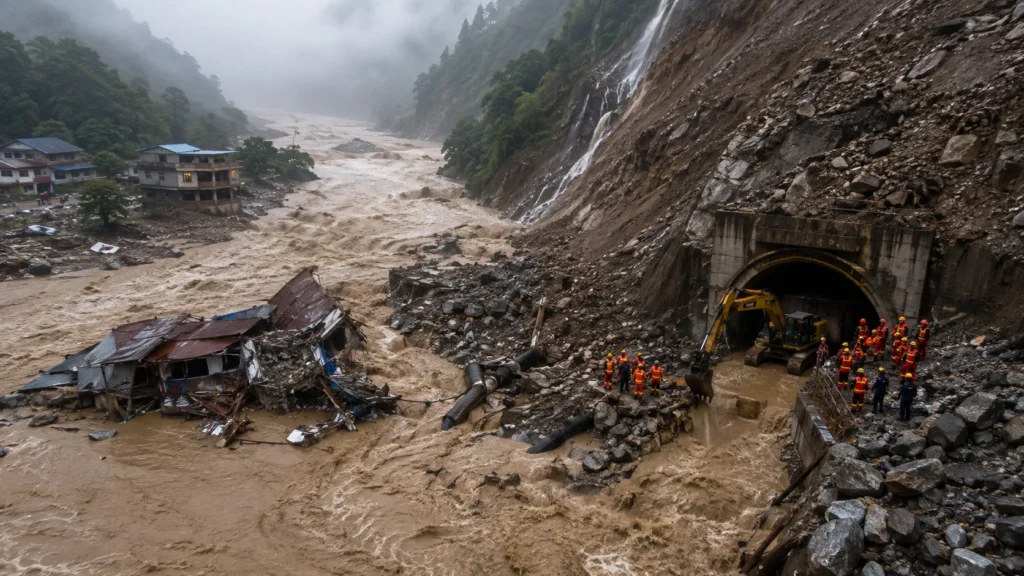
The demand comes after a catastrophic flash flood struck the Bhotekoshi River basin on August 26. A massive rock-and-ice collapse near the Nepal-Tibet border sent a destructive surge of water, mud and debris downstream. The disaster swept through communities, damaged roads and bridges and caused extensive destruction across parts of Nepal.
More than 1,100 people have been confirmed dead, while thousands remain missing as rescue teams continue searching disaster-hit areas. The scale of the destruction has placed enormous pressure on Nepal’s limited resources and raised questions about how the country will finance reconstruction.
‘Not Charity’, Says Nepal
Khanal has framed Nepal’s demand as part of a wider climate-justice campaign. He said Kathmandu was moving away from a traditional approach centred on receiving aid and towards seeking compensation for losses linked to climate change.
According to the minister, China, the United States and India are among the countries whose large greenhouse-gas emissions have contributed significantly to the global climate crisis. Nepal, by contrast, has a very small contribution to global emissions but faces serious consequences from a warming planet.
Khanal said the issue should be viewed as a question of legal and moral responsibility rather than charity. Nepal intends to raise the matter more forcefully at international forums, including upcoming global climate discussions.
The argument reflects a long-running concern among vulnerable developing countries. Many of these nations say they are experiencing increasingly severe floods, storms, droughts and other climate-related disasters despite having contributed relatively little to historical emissions.
Himalayas at the Centre of the Crisis
Nepal’s geographical position makes it particularly vulnerable to environmental changes in the Himalayas. The country depends heavily on its mountain ecosystems and rivers, while millions of people across South Asia rely on water originating in the Himalayan region.
Climate change is accelerating changes in mountain environments, including glacier retreat and instability in high-altitude areas. Scientists and environmental experts have repeatedly warned that such changes can increase the risks associated with glacial lakes, landslides and sudden floods.
The latest disaster has once again drawn attention to the vulnerability of communities living downstream from the high mountains.
For Nepal, the consequences go beyond the immediate loss of lives. Roads, bridges, homes, businesses and energy infrastructure have been damaged, creating a potentially enormous reconstruction bill.
Nepal Turns to Loss and Damage Fund
Alongside its diplomatic campaign, Nepal has formally sought urgent financial assistance through the international Loss and Damage Fund.
The mechanism was created to help developing countries deal with the consequences of climate change that cannot simply be prevented through adaptation. Nepal sees the fund as an important avenue for addressing the economic and social costs of disasters affecting climate-vulnerable countries.
The government’s approach therefore combines immediate humanitarian requirements with a longer-term push for international climate financing.
Khanal has also highlighted the importance of the Himalayan ecosystem to the wider region. The mountains are not only crucial to Nepal but also provide water resources for large populations across South Asia. Damage to the Himalayan environment can therefore have consequences far beyond Nepal’s borders.
India and China Provide Emergency Assistance
Nepal’s call for compensation comes at a time when both India and China are providing emergency assistance following the disaster.
India has sent relief supplies and specialist teams to assist with rescue and recovery operations. Indian personnel have also been involved in efforts connected with damaged hydropower infrastructure and other emergency requirements.
China has been carrying out rescue and recovery operations on its side of the border after the disaster also affected Tibet. Access to the affected region was initially severely restricted after flooding and landslides damaged key transport links. China has since reopened a major road towards the Gyirong border area, allowing rescuers and heavy equipment to move into the disaster zone.
Nepal’s Prime Minister Balendra Shah has publicly thanked India and China for their assistance, highlighting the importance of immediate cooperation during the crisis.
This creates a distinction between emergency relief and the compensation Nepal is now seeking. While aid is helping communities deal with the immediate disaster, Kathmandu wants a broader international mechanism to address long-term climate-related losses.
A New Test for Climate Diplomacy
Nepal’s demand could add momentum to the global debate over who should pay for climate-related disasters. Vulnerable nations have increasingly argued that financial support must match the scale of the damage they are experiencing.
The Himalayan country’s latest position is particularly significant because it links a specific disaster to a much wider question of climate responsibility.
For Nepal, rebuilding after the floods will require more than emergency supplies. Destroyed infrastructure must be reconstructed, displaced communities supported and vulnerable areas made safer against future disasters.
The government now wants the international community to recognise that challenge as part of the global climate crisis.
Whether China, the United States and India accept Nepal’s argument remains uncertain. But Kathmandu’s message is clear: for countries facing severe climate impacts despite minimal emissions, international support should not end with emergency relief. Nepal wants climate justice, financial responsibility and a stronger global commitment to protecting vulnerable nations.
See more: Badshah and Isha Rikhi Part Ways After Five Months of Marriage