

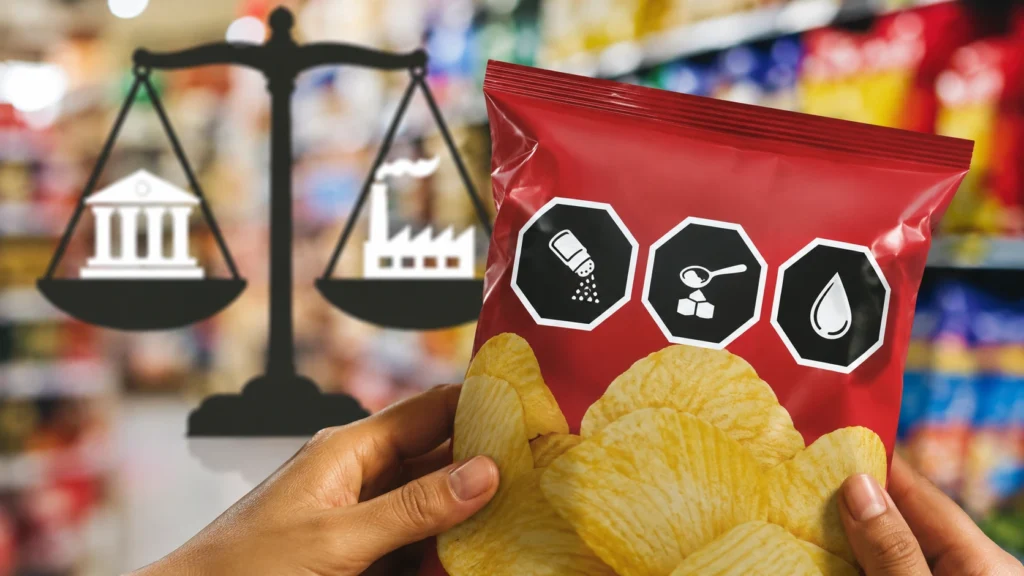

India’s effort to make packaged food labels more transparent has turned into a larger fight over public health, corporate influence and the right of consumers to know what they are buying.
At the centre of the dispute is a relatively simple proposal: put clear warning symbols on the front of packets and bottles when products contain high amounts of sugar, salt or fat. Instead of forcing shoppers to study small nutritional tables on the back, the idea was to give them an immediate visual signal.
That proposal, however, has faced strong resistance from sections of the packaged-food industry. A Reuters investigation reported that the Food Safety and Standards Authority of India (FSSAI) moved away from its earlier push for colour-coded front-of-pack warnings following a March 2026 meeting with industry representatives. The regulator later proposed a black-and-white nutritional table instead.
A Label That Could Change Buying Decisions
Front-of-pack warning systems are designed around one basic principle: consumers should not need specialist nutritional knowledge to understand a product.
A prominent red symbol indicating high sugar or salt can communicate information within seconds. This becomes particularly relevant when shoppers are choosing breakfast cereals, biscuits, instant noodles, packaged snacks, soft drinks or other heavily marketed products.
Health experts and activists supporting stronger labelling argue that consumers frequently make purchasing decisions based on advertising, packaging and price rather than detailed nutritional information.
India already requires packaged food manufacturers to provide nutritional information. The argument is therefore not about whether information should exist, but whether it should be presented in a way that ordinary consumers can easily understand.
Why The Food Industry Objected
Industry representatives have questioned whether a simple warning symbol can accurately capture the nutritional character of every product.
During the March meeting reported by Reuters, industry representatives argued that warning labels could be misleading and ineffective. They also promoted portion control and consumer education as alternative approaches.
One concern raised by the industry is that a system based purely on nutrient thresholds could place warning labels on products containing naturally occurring sugars. The industry has argued that such classifications may not always distinguish between different types of foods and their wider nutritional context.
The debate becomes particularly important because a large share of India’s packaged-food market could potentially fall under a high-fat, high-sugar or high-salt classification. Industry representatives warned that this could result in warning symbols appearing across a huge range of products.
The Supreme Court Enters The Debate
The issue has now moved beyond regulatory discussions.
Public health activists have challenged India’s approach to front-of-pack labelling, bringing the matter before the Supreme Court. Earlier this year, the court asked regulators to examine international models, including Israel’s system of prominent warning indicators.
The regulator’s decision to step away from the stronger colour-coded approach has subsequently attracted judicial scrutiny.
The Supreme Court has emphasised that the country’s regulatory framework should take public health seriously. The court’s intervention has added pressure on authorities to explain why India should adopt a weaker or different system when several other countries have already introduced interpretive food labels.
India And The Global Labelling Gap
India’s debate is also significant because front-of-pack interpretive labelling is no longer an experimental idea.
Around 20 countries have introduced systems that make nutritional warnings easier to understand. Depending on the country, packages may display red warnings for high levels of certain nutrients or other simple visual indicators.
The controversy becomes sharper when multinational companies operate under different labelling environments in different markets.
Reuters reported differences between products sold in India and overseas markets. For example, Fanta sold in London reportedly contains substantially less sugar than the Indian version, while European rules can require prominent warnings for certain artificial colours. In India, information about the colourant may appear in smaller print on the back of the package.
The report also highlighted differences involving products such as KitKat and Maggi.
According to the investigation, standard Indian KitKat contains 4.5% cocoa solids, while an Australian version contains at least 22% cocoa in its milk chocolate. It also reported that Indian Maggi variants use palm oil, while several British versions use sunflower oil and carry front-of-pack salt warnings.
Different Recipes, Different Reasons
Food manufacturers often produce different versions of the same brand for different countries.
Companies can change recipes because of local regulations, consumer preferences, ingredient availability, pricing and purchasing power. That means differences between two countries do not automatically prove that one market is being deliberately treated unfairly.
However, the differences have become a major point of discussion among Indian consumers.
Social-media campaigns have increasingly encouraged people to compare labels and ingredients across countries. The debate has therefore moved from regulatory offices to smartphones, supermarkets and online communities.
The Rise Of Food Activism
One of the most visible voices in India’s packaged-food debate is Revant Himatsingka, popularly known online as Food Pharmer.
His social-media content focuses on ingredients, sugar levels, marketing claims and differences between products sold in India and other markets. His following has grown to more than five million across YouTube and Instagram, according to the Reuters report.
His activism has also brought legal challenges. In 2023, PepsiCo obtained a Delhi court order concerning one of his videos about its Sting beverage. Indian regulators later ordered PepsiCo and other companies to stop using the term “energy drink” in certain marketing contexts within a specified period.
The episode reflects a wider change: consumers are increasingly questioning not only what is written on food packets, but also how products are advertised.
Regulators Under Increasing Pressure
The food-labelling controversy comes as FSSAI faces broader scrutiny over misleading claims and food marketing.
Recent reports said the regulator issued more than 150 notices to food businesses over misleading advertisements, false claims and labelling-related violations. Another recent enforcement action targeted claims such as “100%” and “energy drink”, with companies being asked to make corrective changes.
These developments suggest that food regulation in India is entering a more aggressive phase.
The challenge for authorities is to create rules that are scientifically sound, easy for consumers to understand and difficult for companies to manipulate.
What This Means For Consumers
For shoppers, the outcome could have a direct impact on everyday purchases.
A strong front warning system could make it easier to compare two products quickly. It could also push manufacturers to reformulate products by reducing sugar, salt or unhealthy fats in order to avoid prominent warnings.
But labelling alone cannot solve India’s nutrition challenges.
Consumer education, healthier product choices, better school nutrition and clearer advertising rules would also play important roles. The question is whether a simple warning label can become one useful tool within that larger strategy.
A Bigger Question For India
India’s food-labelling dispute is ultimately about more than red symbols on packets.
It raises a fundamental question: when a consumer buys a product, should the most important health information be immediately visible or hidden inside a detailed nutritional panel?
As India’s packaged-food market expands and concerns about obesity and diet-related diseases grow, the answer could influence how food companies formulate, advertise and package their products.
A recent study cited by Reuters estimates that around 450 million Indians could be overweight or obese by 2050.
The Supreme Court’s scrutiny could therefore become a crucial moment in India’s food-policy landscape. Whether the country eventually adopts red warning labels, another interpretive system or a modified nutritional framework, the larger demand from consumers remains the same: clear information before the purchase, not after it.
See more: Delhi-NCR Rain