
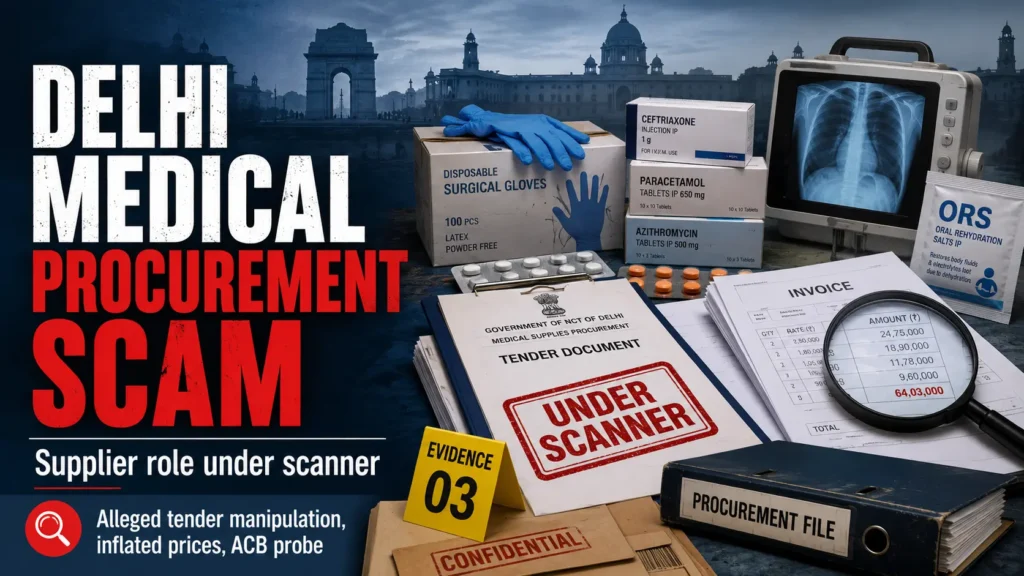

The investigation into the alleged Delhi medical procurement scam has widened, with the Anti-Corruption Branch examining the role of a supplier accused of influencing tenders and operating several front firms.
Investigators suspect that the supplier acted as a broker between manufacturers, private companies and government officials. The alleged irregularities relate to the purchase of medicines, surgical supplies, consumables and medical equipment for Delhi’s public health facilities.
The value of the procurements under investigation is now reported to be around ₹700 crore. However, the allegations have not yet been proved in court, and the investigation remains active.
What is the Delhi medical procurement scam?
The case centres on purchases made through the Central Procurement Agency, or CPA, which functions under Delhi’s Directorate General of Health Services.
Delhi’s Directorate of Vigilance began examining the procurement process after receiving complaints about possible irregularities. Vigilance officials reportedly conducted searches at CPA offices in May 2026.
The complaint was later converted into an FIR by the ACB on June 2. It alleged that public officials and private individuals worked together to manipulate tenders and benefit selected companies.
The investigation covers the procurement of:
- Medicines and ORS sachets
- Surgical dressings, sutures and gloves
- Hospital linen and bedsheets
- Portable X-ray machines
- C-arm radiology equipment
- Anaesthesia workstations
- Other medical consumables and equipment
How were the tenders allegedly manipulated?
According to the complaint cited in media reports, tender conditions were allegedly designed to suit pre-selected companies.
Investigators suspect that manufacturers first selected particular distributors. The supplier or broker then allegedly helped prepare restrictive technical specifications that matched products offered by those firms.
Conditions related to turnover, experience and past performance were reportedly kept unusually high. As a result, genuine competitors may have found it difficult to qualify. Meanwhile, companies allegedly controlled by the same network were allowed to participate.
The complaint further alleges that:
- Technical evaluation documents were prepared outside the normal process.
- Financial bids were opened without adequate transparency.
- Some approvals were issued within hours of bid opening.
- Purchase orders were processed manually.
- Regular e-procurement and Government e-Marketplace workflows were allegedly bypassed.
- Completed tenders remained listed as “Active” or “Under Process” on public portals.
Investigators are also examining claims that payments linked to the alleged network were cleared within one or two days. In contrast, payments owed to some regular suppliers reportedly remained pending for months or even years.
Supplier accused of controlling front companies
The supplier’s role has become a major focus of the Delhi medical procurement scam investigation.
The Vigilance Department’s complaint reportedly names several firms suspected of being used as fronts. Investigators believe the supplier may have been the actual operator behind some of these businesses.
He is also accused of coordinating with manufacturers, deciding supply rates and arranging alleged kickbacks. Tender papers prepared by the network were reportedly routed through senior officials for approval.
The ACB has said that his role is under examination. Further questioning or legal action will depend on the evidence collected during the investigation.
Delhi medical procurement scam: Inflated prices under investigation
The probe is also examining claims that several products were purchased at prices far above their estimated market value.
According to the Vigilance Department’s allegations:
- Portable X-ray machines costing around ₹10 lakh were allegedly billed at ₹33 lakh each.
- Hospital bedsheets estimated at ₹150 per piece were reportedly purchased for ₹450.
- ORS sachets with an estimated market price of ₹2.50 were allegedly bought for ₹15 each.
- Surgical consumables were also reportedly purchased at inflated rates.
These figures form part of the allegations being investigated. They should not be treated as established findings until the inquiry and any subsequent court proceedings are completed.
Three officials arrested as probe expands
The ACB has arrested three former officials in connection with the case.
Former CPA Head of Office Dr Vinod Kumar Ranga was arrested in mid-June. Former Director General of Health Services Dr Vatsala Aggarwal and former Deputy Controller of Accounts Neeraj Chopra were arrested later during the investigation.
Investigators are reportedly examining the possible involvement of around 10 other government officials. Several contractors, bidders and private individuals have also come under scrutiny.
ED seeks procurement records
The Enforcement Directorate has also sought records related to the case from the DGHS.
The requested documents reportedly cover purchases of medicines, portable X-ray machines, surgical supplies, hospital linen and other medical equipment. The agency’s interest could lead to a separate examination of the financial trail under the Prevention of Money Laundering Act.
However, the ACB remains responsible for the main corruption investigation at this stage.
Delhi medical procurement scam: What will investigators examine next?
The investigation is expected to focus on tender files, company ownership records, payment details and procurement portal data.
Officials may also examine whether apparently separate bidders were controlled by the same individuals. Bank transactions and corporate records could help establish whether public money moved through shell or front companies.
Another major question is whether officials deliberately kept tender information hidden from competing suppliers and the public.
Conclusion
The Delhi medical procurement scam raises serious questions about transparency in the purchase of essential supplies for government hospitals.
The ACB is now attempting to determine how tenders were prepared, who controlled the participating companies and where the money ultimately went. The supplier’s alleged role could prove important in connecting manufacturers, front firms and officials.
Nevertheless, the claims remain allegations. The final scale of the financial loss and the responsibility of each accused person will depend on evidence collected during the continuing investigation.
Read Also: Ram Temple Cash Counting Case: Six Security Firm Employees Among Eight Arrested
Follow Us on Instagram: bh24newsweb