

UPI Charges From October 15: 0.4% MDR on Transactions Above ₹2,000
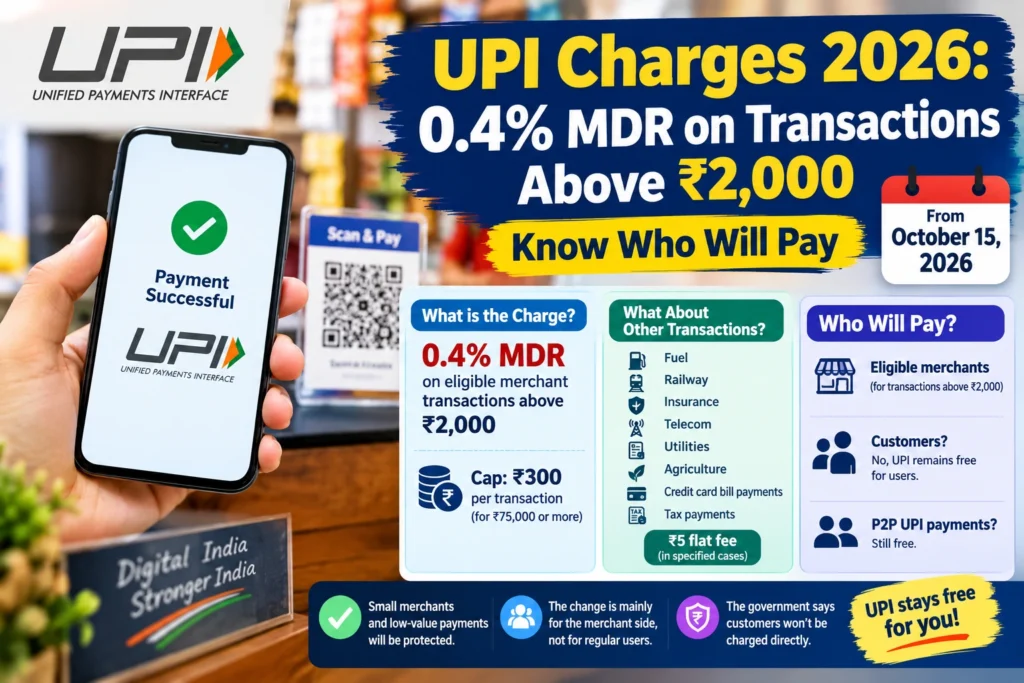
UPI payments are set for an important change from October 15, 2026. A new Merchant Discount Rate (MDR) of 0.4% will apply to eligible person-to-merchant (P2M) UPI transactions above ₹2,000.
The new rule is aimed mainly at eligible merchants and larger businesses. Person-to-person UPI payments will continue to remain free. The government has also said that the new merchant charge should not be passed on to customers.
What Is the New UPI Charge?
Under the new system, eligible merchant UPI transactions above ₹2,000 will attract an MDR of 0.4%.
For transactions of ₹75,000 or more, the MDR will be capped at ₹300 per transaction.
For certain categories such as fuel, railway, insurance, telecom, utilities, agriculture, credit-card bill payments and tax payments, a different flat charge of ₹5 per transaction will apply in specified cases rather than the standard 0.4% rate.
Will Customers Have to Pay the UPI Charge?
For ordinary customers, UPI will remain free.
The new MDR is a charge on eligible merchant-side transactions, not a direct fee on the customer making the payment. Person-to-person transfers will also remain free.
According to MobiKwik co-founder and CEO Upasana Taku, the change is expected to affect the merchant side of the payment ecosystem rather than ordinary users. Aaj Tak reported that she described the new MDR as a long-standing demand from payment companies because processing UPI transactions involves infrastructure and technology costs.
What About Small Shops?
The new framework is designed to protect smaller merchants from the main MDR burden.
Aaj Tak’s report, citing Taku, says small vendors and many low-value everyday transactions such as grocery purchases, vegetables, coffee and taxi payments would not be affected by the standard MDR.
The exact treatment depends on the merchant category and the applicable rules, so not every payment above ₹2,000 should automatically be assumed to carry the same charge.
Why Has UPI MDR Been Introduced?
UPI has grown rapidly, but payment companies and banks have had to bear the costs of running the infrastructure.
Taku said that payment companies had been asking for a way to monetise at least part of the UPI ecosystem. She also pointed to costs related to servers, fraud prevention, cybersecurity, innovation and future infrastructure.
The government and NPCI’s new framework therefore introduces a merchant-side revenue model while keeping many everyday and person-to-person payments free.
How Much Could MobiKwik Earn?
MobiKwik CEO Upasana Taku said the company expects the new UPI MDR system to generate around ₹150 crore in additional revenue in the next financial year, apart from its normal business growth.
She also said the eventual impact on profits could be significant, although the company was still studying the detailed circular and its financial implications.
Example: What Does 0.4% Mean?
If an eligible merchant receives a ₹5,000 UPI payment, 0.4% of ₹5,000 is:
₹20
For a ₹10,000 eligible transaction:
₹40
However, this is a merchant-side MDR calculation. It does not mean that the customer will automatically see ₹20 or ₹40 deducted from their bank account.
What Will Remain Free?
Several types of UPI payments will continue without the standard 0.4% MDR, including:
- Person-to-person UPI transfers
- Eligible transactions of ₹2,000 or below
- Many everyday low-value merchant payments
- Specified essential-service transactions under their separate fee structure
The exact exemption depends on the transaction and merchant category.
What Changes From October 15?
The major change is that UPI will no longer be completely zero-MDR for every eligible merchant transaction.
From October 15, 2026, eligible P2M transactions above ₹2,000 will carry the new 0.4% MDR, subject to applicable caps and category-specific rules.
For ordinary users, however, the change does not mean that UPI itself is becoming a paid service.
Main Points
- New UPI MDR rules start from October 15, 2026.
- 0.4% MDR applies to eligible merchant transactions above ₹2,000.
- MDR is capped at ₹300 for transactions of ₹75,000 or more.
- P2P UPI payments remain free.
- Customers are not supposed to be directly charged the MDR.
- Certain essential services have a separate ₹5 flat fee structure.
- MobiKwik expects around ₹150 crore additional revenue from the new MDR, according to CEO Upasana Taku.
- The impact is mainly on the merchant/payment ecosystem, rather than ordinary UPI users.
NEXT NEWS –https://bh24news.com/ashneer-grover-upi-merchant-fee/