
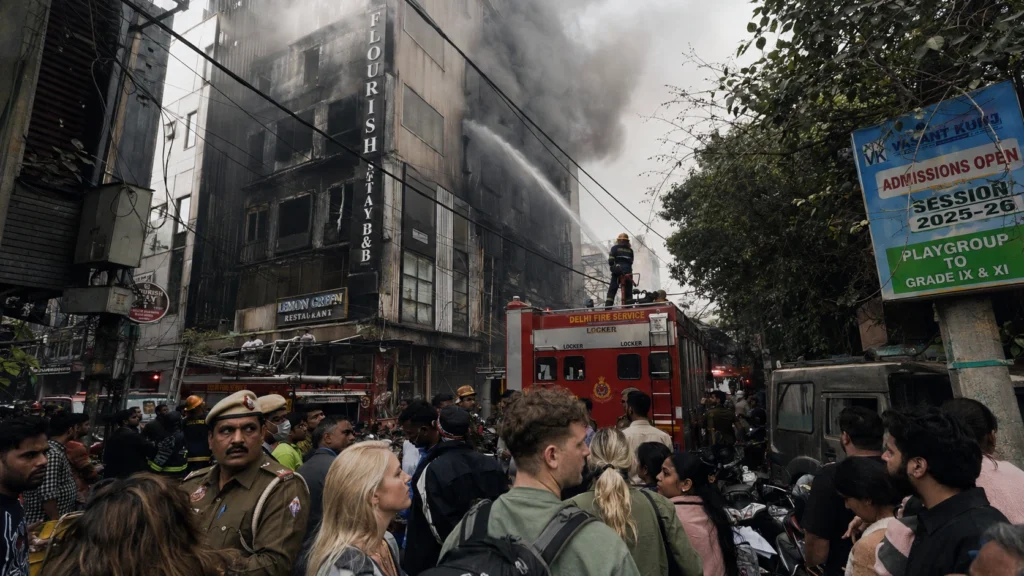

A catastrophic fire swept through a multi-storey budget hospitality facility in South Delhi’s congested Hauz Rani commercial enclave on Wednesday morning, killing at least 21 people and leaving dozens more fighting for survival. The devastating Malviya Nagar hotel fire has sent shockwaves through the national capital after municipal rescue agencies confirmed that the vast majority of those who lost their lives were foreign nationals residing in India as medical tourists. The building, which functioned as a highly populated transit lodging hub operating under the name Flourish Stay B&B, became a vertical smoke trap within minutes as dense, toxic fumes completely cut off access to the building’s lone central stairwell.
The disaster unfolded during early morning operational hours when approximately 50 international guests were inside the premises. Ground reports indicate that the blaze originated around 8:45 AM in the lowest segments of the property, which housed the Lemon Green Restaurant. Within moments, flames swept across the ground level and climbed up the vertical utility shafts, trapping weak patients and their family caregivers on the upper residential floors. Emergency response units faced an incredibly difficult task as they worked to extract unconscious occupants from the burning, window-locked structure.
Flashover Timeline and Interior Smoke Logging
Eyewitness accounts describe a series of muffled explosions coming from the basement kitchen area, indicating either a high-voltage electrical distribution failure or a sudden breach in commercial liquefied petroleum gas (LPG) cylinder lines. Because the ground and lower mezzanine segments featured extensive synthetic wood paneling, false ceilings, and heavy foam acoustic insulations for the restaurant layout, the thermal energy multiplied at an extreme pace. The fire quickly consumed the ground floor before climbing upward through the central elevator shafts and air-duct grids.
As smoke entered the individual rooms on the top three floors, sleeping occupants were woken by severe breathing distress. By 9:00 AM, thick columns of black smoke had filled the narrow alleys of Hauz Rani, drawing hundreds of panicked local residents to the site. Because the building lacked open balconies and secondary emergency fire exits, trapped residents crowded around glass panel windows, screaming for assistance as the structural temperature rose inside the sealed building. The lack of natural ventilation turned individual hotel rooms into high-heat containment zones, causing the rapid degradation of internal plastic fixtures and PVC wiring conduit sleeves.
The internal construction materials played a massive role in how fast the situation deteriorated. The rapid breakdown of polyurethane foam cushions and synthetic carpeting generated large amounts of hydrogen cyanide and carbon monoxide gas. This toxic mix moved up the elevator shafts much faster than the actual flames, rendering many victims unconscious in their rooms before they could even reach the doors. This rapid accumulation of gas explains why a significant majority of the casualties showed minimal external thermal burns but severe respiratory damage.
Community Heroism Amidst Institutional Hurdles
Before the formal arrival of municipal emergency machinery, local traders and residents took rescue matters into their own hands. In a dramatic rescue captured on video, a foreign woman was seen trapped on a top-floor ledge surrounded by smoke. Acting quickly, neighborhood youths gathered commercial mattresses from nearby residential stores and aligned them on the narrow street below. Encouraged by the crowd, the woman leaped from the burning building, hitting the makeshift cushions and surviving with non-fatal impact injuries.
Dozens of other occupants attempted to construct vertical escape lines using bedsheets tied together, while others risked serious fractures by jumping directly onto neighboring concrete roofs. Local volunteers pushed through the lower smoking entryways to haul out unconscious survivors before extreme heat forced them back. Sadly, those who stayed inside their sealed, air-conditioned rooms succumbed rapidly to carbon monoxide poisoning.
The structural density of the Hauz Rani market area severely complicated community-led rescue attempts. The space between adjacent buildings was minimal, allowing thermal radiation to crack window panes on facing properties. Local shopkeepers deployed portable chemical fire extinguishers gathered from nearby retail outlets, but the sheer scale of the basement-fueled conflagration required deep high-pressure water streams that only heavy municipal tenders could provide.
Vulnerability of International Medical Tourists at Flourish Stay B&B
The most heartbreaking aspect of the tragedy centers on the demographic background of its primary victims. The Hauz Rani and Malviya Nagar neighborhoods sit right across from major corporate hospital zones in Saket, making them primary hubs for budget international medical lodging. Investigators verified that the hotel rooms were almost entirely occupied by international patients and their family caregivers arriving from Central Asian republics (including Uzbekistan and Kazakhstan) and various African countries.
Many of these tourists were in Delhi recovering from complex cardiovascular operations, organ transplants, or oncological procedures, leaving them physically weak and unable to move quickly when the emergency started. Hospital casualty logs highlight this physical vulnerability. Max Hospital in Saket received 39 patients from the disaster scene, with 18 declared dead on arrival. Concurrently, the AIIMS Trauma Centre took in 13 victims, including three individuals who had succumbed to severe internal smoke inhalation prior to arrival.
Medical coordinators specializing in international patient care noted that these transit guest houses are rarely equipped to handle less-mobile individuals. The absence of ramps, visual emergency markers in multiple languages, and clear safety briefings meant that foreign guests were completely dependent on external rescue teams to navigate the unfamiliar, dark corridors during the crisis. Many victims were physically unable to attempt the high-risk vertical escapes or roof jumps that saved their healthier neighbors.
First Responder Casualties and Operational Hurdles
The deadly nature of the building’s interior layout also took a heavy toll on the initial rescue squads. Ten rescue personnel—consisting of Delhi Fire Service operational crew members and local beat officers from the Delhi Police—sustained serious injuries during the initial entry phase. Firefighters faced a complete absence of structural visibility, working through toxic fumes emitted by burning artificial rubber carpet underlays and synthetic interior finishes.
Furthermore, the physical geometry of the Hauz Rani market presented a major obstacle to the rescue operation. The extremely narrow approach paths, coupled with illegally parked two-wheelers and commercial delivery vans, meant that heavy hydraulic ladders and broad fire tenders could not secure direct placement adjacent to the structure’s frontage. Firefighters had to extend manual hose lines across hundreds of meters of winding lanes, losing vital setup time during the peak phase of the inferno.
Despite these massive constraints, fire crews managed to bring out more than 40 people alive using handheld tools to break through reinforced window grilles. Several officers had to be treated for smoke inhalation alongside hotel guests after giving up their personal oxygen masks to children trapped on the upper floors. The injured first responders were admitted to local government facilities, with two firemen reported to be in critical condition due to pulmonary lining inflammation.
Structural Failures Exposed in the Malviya Nagar Hotel Fire
As structural investigators unpack the sequence of events behind the Malviya Nagar hotel fire, early findings indicate massive compliance failures. The property housing Flourish Stay B&B was originally built under residential classifications before being converted into a commercial lodging enterprise. This unauthorized shift bypassed critical safety reviews regarding exit lane configurations, structural load tolerances, and dedicated fire separation bulkheads between the restaurant kitchen and the upper residential floors.
A major focus of the investigation is the complete lack of basic fire mitigation equipment. The building lacked an automated internal water sprinkler network, and the manual fire extinguishers found on the residential levels were long past their expiration dates. Furthermore, the central air conditioning system lacked automatic fire dampers, which allowed it to pump deadly smoke directly into the guest rooms instead of sealing off the affected zones.
The single exit staircase, measuring less than three feet in width, was partially blocked by stored restaurant inventory and extra bedding materials. This safety violation created a lethal bottleneck when guests tried to escape, trapping dozens in the upper corridor as heat and smoke filled the space. Municipal safety teams have emphasized that the Malviya Nagar hotel fire serves as a stark reminder of the zoning violations common across Delhi’s urbanized villages.
PM Modi Announces Compensation Following Malviya Nagar Hotel Fire
The high casualty rate of this disaster prompted immediate high-level political intervention. Prime Minister Narendra Modi expressed his deep sorrow over the tragedy, calling the loss of lives in South Delhi deeply painful. The Prime Minister’s Office (PMO) issued an official social directive confirming immediate economic relief from the Prime Minister’s National Relief Fund (PMNRF). The next of kin of each deceased victim will receive an ex-gratia payment of ₹2 lakh (₹200,000), while individuals recovering from injuries will be allocated ₹50,000.
Delhi Chief Minister Rekha Gupta also expressed her deep condolences, stating that her administration is monitoring the medical care of the survivors. The Chief Minister directed the Centralised Accident and Trauma Services (CATS) ambulance fleet and city health divisions to remain stationed at maximum readiness. “The Delhi Government stands fully with the grieving families,” her statement read. “We have commanded absolute mobilization of diagnostic and intensive clinical care across our state networks to support our international guests.”
The Ministry of External Affairs (MEA) has also set up a dedicated round-the-clock help desk to assist foreign embassies. This desk is working to fast-track the identification process, issue emergency visas for family members traveling to India, and coordinate the respectful return of mortal remains to the victims’ home countries. Diplomatic channels are communicating directly with representatives from Uzbekistan, Kazakhstan, and affected African nations to streamline medical updates and legal documentation.
Malviya Nagar hotel fire: Political Accountability and Magisterial Probe
As rescue workers shifted to searching the charred remains of the building, a sharp political debate emerged over urban safety infrastructure. Visiting the disaster zone, local AAP leader Somnath Bharti leveled sharp criticisms at the timeline of the emergency response. Bharti asserted that despite immediate community notifications, fire response units took nearly 50 minutes to arrive on site, an institutional delay he termed deeply unfortunate given the visible smoke columns.
The Delhi Fire Service strongly pushed back against allegations of negligence, releasing log sheets showing that their first response vehicles left the stations within three minutes of receiving the alarm. They emphasized that city traffic management and unplanned commercial choke points remain the single biggest threat to emergency response times in urban villages. DFS officials stated that until municipal authorities enforce strict anti-encroachment laws on public approach lanes, emergency entry times will remain heavily compromised.
Local administrative head Jitendra Kumar, serving as the Sub-Divisional Magistrate (SDM), announced the immediate activation of the District Disaster Management Authority (DDMA) investigative cell. The magisterial inquiry is explicitly mandated to audit the structural origins of the facility and verify how a complex commercial lodging house was permitted to run in a dense market lane without high-capacity safety pathways. The inquiry will also look into potential corruption within municipal licensing departments that allowed Flourish Stay B&B to operate without a valid Fire No Objection Certificate (NOC).
Systematic Licensing Crackdown and Structural Audits
Local business owners operating within Hauz Rani noted that the fallout from the Malviya Nagar hotel fire will have a lasting effect on the neighborhood’s economy. The area has built its entire commercial model around supporting international medical travelers, with hundreds of properties modified to serve as transit lodging houses. Local traders express concern that structural safety violations by a few negligent owners could destroy the reputation of the entire medical tourism hub.
In response, the city administration has ordered an immediate safety review of all budget bed-and-breakfast operations, transit guest houses, and basement restaurants across congested medical transit sectors like Hauz Rani, Paharganj, Karol Bagh, and Connaught Place. Establishments found to have blocked staircases, non-functional extinguishers, or unapproved building expansions will face immediate closure, as authorities look to reform the city’s hospitality safety standards.
The Municipal Corporation of Delhi (MCD) has announced that moving forward, no transit hospitality permits will be issued or renewed for properties located in streets less than six meters wide. This policy shift aims to ensure that fire engines can always secure direct access to structures during future emergencies. While this decision faces pushback from local property associations citing economic losses, municipal regulators insist that public safety must take precedence over commercial interests to prevent another tragedy like the Flourish Stay B&B disaster.
Read Also: Patna News: खान सर के कोचिंग संस्थान पर हमला
Follow us on Instagram: bh24newsweb