

Introduction
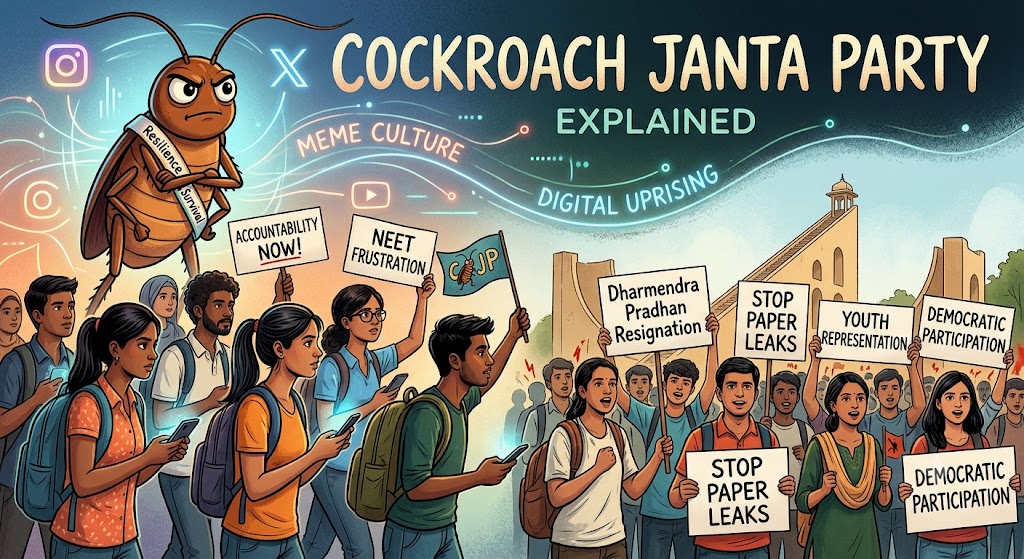
In the hyper-polarized landscape of Indian politics, grassroots movements traditionally sprout from established student unions or seasoned political factions. However, a new phenomenon has completely upended this paradigm. The Cockroach Janta Party (CJP), a satirical political movement, has evolved from a simple internet meme into a nationwide youth campaign challenging India’s premier administrative and judicial systems.
What started as a digital outcry has rapidly spilled onto the streets. The party’s founder, Abhijeet Dipke, officially announced his return to India on June 6, 2026, aiming to spearhead a massive, peaceful demonstration at Delhi’s historic Jantar Mantar. The core demand? The immediate resignation of Union Education Minister Dharmendra Pradhan over systemic failures in national competitive exams.
As this satirical front prepares to test its monumental digital strength in the real world, a critical question arises for observers across the country: How did a party named after a household pest capture the collective consciousness of India’s Gen Z?
How Did the Cockroach Janta Party Start?
The genesis of the Cockroach Janta Party can be traced back to a specific, explosive moment inside the Supreme Court of India. On May 15, 2026, during a high-stakes court hearing concerning procedural misuse of courts, remarks attributed to the incumbent Chief Justice of India (CJI), Surya Kant, went viral. The bench used the terms “cockroaches” and “parasites of society” while addressing certain factions of online critics and litigants.
While Chief Justice Surya Kant later clarified that his comments were completely misunderstood, taken out of context, and directed solely at individuals manipulating administrative systems with fake degrees, the damage on social media was already done.
For millions of young Indians grappling with career anxieties, delayed recruitment cycles, and exam cancellations, the word “cockroach” stung deeply. It felt like an institutional dismissal of their systemic struggles.
Recognizing the simmering rage online, Abhijeet Dipke—a Boston University graduate and former digital communications strategist—turned the insult into a political shield. On May 16, 2026, Dipke formally launched a parody platform named the Cockroach Janta Party (CJP), explicitly calling it a dedicated space for all the “cockroaches” out there.
The Symbolism: Why the “Cockroach” Resonates
In branding, irony can be a potent weapon. The CJP deliberately chose the insect as its mascot to mock elite dismissiveness while embodying a deeper metaphor for survival.
According to the movement’s digital manifesto, the cockroach represents the ultimate survivor. It can adapt to the most hostile environments, withstand extreme pressures, and stubbornly exist despite relentless attempts by higher powers to eradicate it.
To the average Indian student or unemployed youth, the metaphor hit close to home. The insect became a symbol for the ordinary citizen pushing through:
- Abrupt exam cancellations and paper leaks
- Stagnant job markets and hyper-competition
- An apparent lack of institutional accountability
By turning a derogatory label into a badge of honor, the movement fostered an instant, empathetic connection with an entire generation of digital-native voters.
Who is Abhijeet Dipke? The Mind Behind the Parody
To understand the tactical genius behind the CJP’s meteoric rise, one must look at its founder. Abhijeet Dipke is not a political novice. Between 2020 and 2023, Dipke served as a prominent volunteer within the Aam Aadmi Party’s (AAP) social media wing. During the 2020 Delhi Legislative Assembly elections, he was instrumental in crafting the meme-centric digital content that successfully attracted young, first-time voters to Arvind Kejriwal’s camp. He subsequently worked as a communications advisor for the Delhi government’s education department before moving to the United States for higher studies.
Leveraging his deep understanding of digital algorithms, internet culture, and youth psychology, Dipke utilized advanced artificial intelligence models like ChatGPT and Claude to draft a parodied, yet highly sophisticated, political manifesto.
While critics label him an opportunistic digital disruptor, Dipke maintains that the CJP is a completely independent, non-affiliated platform. It exists solely to give voice to a demography that feels structurally abandoned by both the ruling dispensation and the traditional opposition.
Breaking the Internet: The Mind-Boggling Statistics Of Cockroach Janta Party
The growth metrics of the Cockroach Janta Party have stunned political analysts and digital marketers alike. The movement did not just go viral; it shattered existing Indian social media records:
| Social Platform | CJP Follower Milestone | Contextual Comparison |
| 22+ Million Followers | Overtook the official handles of the BJP and Congress within days of launching. | |
| X (formerly Twitter) | 100,000+ Followers | Achieved despite stringent algorithmic suppression and regional blocks. |
| Official Membership | 350,000+ Digital Registrations | Signed up via independent online verification forms within days of launch. |
What is the Motto and Manifesto of the Cockroach Janta Party?
Though it functions under the banner of political satire, the Cockroach Janta Party outlines distinct socio-political objectives. On its official domain, the party describes its ideological stance as a youth front that is: “Secular, Socialist, Democratic, and Lazy.”
The underlying text, however, targets severe institutional issues:
- Absolute Governance Accountability: A relentless demand for public officials to explain the direct utilization of taxpayer money.
- Protection of Student Rights: Ensuring the sanctity of national-level entrance examinations and eliminating corruption in boards.
- Dismantling Elitism: Openly criticizing top-tier bureaucrats, politicians, and judicial heads who seem disconnected from grassroots realities.
“We are not here to set up another PM CARES, holiday in Davos on the taxpayer’s salary slip, or rebrand corruption as ‘strategic spending.’ We are here to ask, loudly, repeatedly, in writing, where the money went,” the CJP official website states.
Escalating Tension: Geopolitics, High Court Battles, and Bans
As the CJP’s numbers eclipsed those of mainstream political parties, the establishment’s reaction shifted from amusement to alarm.
Citing national security concerns and inputs from the Intelligence Bureau (IB), the Ministry of Electronics and Information Technology (MeitY) issued an emergency directive under Section 69(A) of the IT Act, effectively ordering X to block the Cockroach Janta Party’s handle for users residing within India. Senior leaders of the ruling party openly alleged that the massive digital handle was receiving covert foreign backing to systematically destabilize public trust in Indian democratic institutions.
In response, Dipke filed an urgent petition in the Delhi High Court challenging the censorship block. However, the High Court refused to pass an immediate interim order to unblock the account, further intensifying the stand-off between the digital movement and state machinery.
The Spark for the Jantar Mantar Protest: The NEET-UG Scandal
The upcoming on-ground escalation is tied directly to the massive administrative crisis surrounding the NEET-UG 2026 examination. Originally held on May 3, the medical entrance test—taken by over 22 lakh aspirants—was plagued by widespread allegations of a coordinated paper leak involving translated question sets and illicit intermediaries.
The subsequent cancellation of the examination and reports of related student suicides sparked nationwide grief and anger. In a video statement that garnered millions of views across platforms, Dipke announced his final plans to fly into New Delhi on June 6, 2026. He urged his massive follower base to meet him directly at the airport, from where they plan to march to the Parliament Street Police Station to seek official clearance for a peaceful, democratic sit-in at Jantar Mantar.
[NEET-UG Exam Controversy] ──> [Student Frustration & Grievances] ──> [CJP Digital Mobilization] ──> [June 6 Jantar Mantar Street Protest]
Dipke has emphasized that the protest will strictly adhere to constitutional means, explicitly invoking the non-violent philosophies of Mahatma Gandhi, Dr. B.R. Ambedkar, and Bhagat Singh. Addressing rampant public speculation regarding his potential arrest the moment he lands, Dipke stated, “How long will we live in fear? This country does not belong to any one party. It belongs to all of us.”
Conclusion: Can Satire Transition to Serious Politics?
The ultimate trajectory of the Cockroach Janta Party hinges entirely on what unfolds in the national capital this June. Historically, turning digital clicks, shares, and viral reels into physical, sustained street mobilization is one of the hardest challenges in political activism.
Whether the Jantar Mantar protest turns into a historical gathering or fizzles out as an online-only phenomenon, the CJP has already proven a vital point. India’s youth are incredibly adept at navigating digital ecosystems to bypass traditional media, constructing their own platforms of dissent using humor and collective empathy. Mainstream political entities can no longer afford to ignore the roaring voice of a generation that refuses to be brushed aside.
Read Also: NEET UG 2026 परीक्षा अब 21 जून को होगी, पेपर लीक विवाद के बाद NTA का बड़ा फैसला